 Premier League
 Champions League
 LaLiga
 Serie A
 Bundesliga
 Ligue 1
 National teams
 MLB
 CPBL
 NPB
 KBO League
 Taiwanese players abroad
 League of Legends
 VALORANT
 CS2
 Dota 2
Football Substitution and Added Time Rules: Five Substitutions, Concussion Substitutions, and How Added Time Is CalculatedGuides · Football · Formats & rules
Key points
- Maximum of 5 substitutions per team, but only 3 substitution opportunities
- Substitutions made at half-time do not count toward the 3 opportunities
- Champions League 2026/27 regulations have no concussion substitutions
1Key Takeaways
- Each team can make a maximum of 5 substitutions, but only has 3 "substitution opportunities"; substitutions made at half-time do not count toward the 3 opportunities. (IFAB Law 3)
- Concussion substitutions are additional: IFAB permits competitions to adopt them, with a maximum of 1 per team per match, not counting toward the 5-substitution quota; the Champions League 2026/27 regulations do not have this provision. (IFAB Concussion Substitution Protocol, Champions League Regulations Article 56)
- New 2026/27 rule: Substituted players must leave the pitch within 10 seconds; if time is exceeded, the substitute must wait at least 1 minute before entering the pitch. (IFAB Law changes 2026/27)
- Added time is "compensated for whatever is actually lost": Substitutions, injuries, time-wasting, VAR, goal celebrations, etc. must all be compensated, and the referee can only add time, never reduce it. (IFAB Law 7)
2Five Substitutions: 5 Players, 3 Opportunities
IFAB Laws stipulate that when top-tier leagues use 5 substitutions:
- A maximum of 5 substitutions per team.
- A maximum of 3 substitution opportunities during the match; substituting multiple players during the same stoppage only counts as using 1 opportunity.
- Substitutions made at half-time do not count toward the number of opportunities.
(IFAB Law 3)
Therefore, coaches often substitute 2 players at half-time while retaining 3 opportunities in the second half. Conversely, if 3 players have already been substituted across 3 separate stoppages in the second half, no further substitutions can be made even if 2 substitution quotas remain.
How many substitutes can be named on the bench is determined by each competition, with IFAB only limiting it to between 3 and 15 players. (IFAB Law 3) The Premier League allows 9 players (Premier League official website, 2022); the Champions League match sheet allows a maximum of 23 players, meaning 11 starters plus 12 substitutes. (Champions League Regulations Article 55)
The Premier League used 5 substitutions during the pandemic, later reverted to 3, and only restored 5 substitutions starting from the 2022-23 season. (Premier League official website, 2022)
Extra Time: Champions League Allows a 6th Substitute
Domestic leagues do not have extra time, but Champions League knockout stages do. Under the Champions League 2026/27 regulations:
- A maximum of 5 substitutions and 3 opportunities in regular time.
- When playing extra time, a 6th substitute can be used, and 1 additional substitution opportunity is granted.
(Champions League Regulations Article 56)
In addition, under IFAB Laws, substitutions made between the end of regular time and the start of extra time, or at half-time of extra time, do not count toward the number of substitution opportunities. (IFAB Law 3)
New 2026/27 Rule: 10-Second Pitch Exit
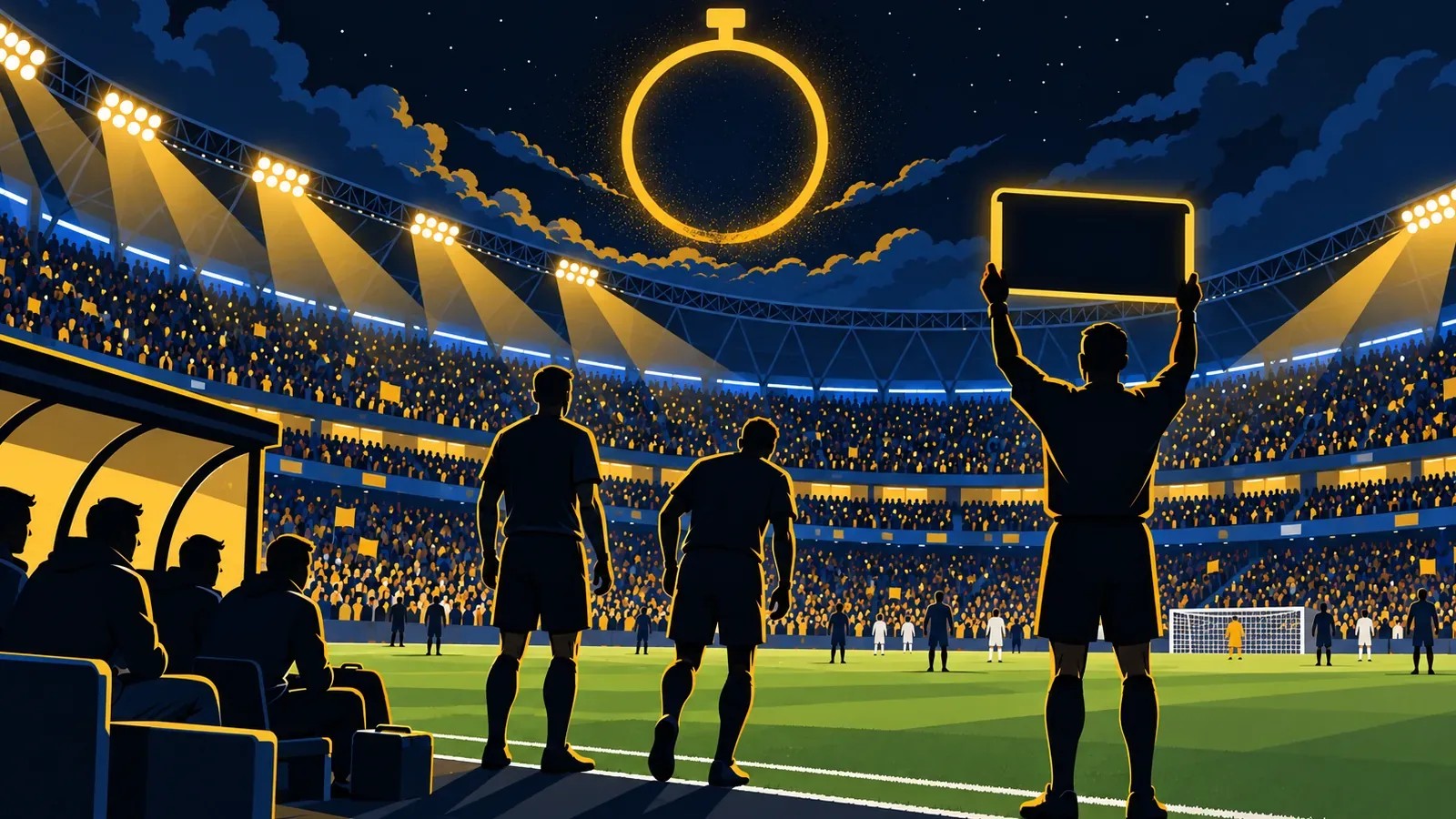
To reduce delays, starting in 2026/27, substituted players must leave the pitch within 10 seconds after the substitution board is raised (or the referee signals). If the 10 seconds are exceeded:
- The substituted player must still leave the pitch; a yellow card is shown only if there is excessive delay in restarting play (exceeding 10 seconds itself does not necessarily result in a card).
- The substitute cannot enter the pitch yet, and play restarts as normal.
- Only after play has restarted and a full 1 minute has elapsed can the substitute enter with the referee's permission at the next stoppage of play.
- This substitution cannot be canceled, nor can a different player be substituted instead.
When multiple players are substituted during the same stoppage, all substituted players must leave the pitch within 10 seconds after the last substitution is signaled. (IFAB Law changes 2026/27)
In other words, the team wasting time on the exit will play with only 10 players for at least 1 minute. The Premier League has adopted this rule for 2026/27. (Premier League official website "How the Laws of the Game are changing in 2026/27")
3Concussion Substitutions: Differences Between the Top Five Leagues and the Champions League
What IFAB Rules Stipulate
IFAB provides an "additional permanent concussion substitution" protocol within the Laws, leaving it to individual competitions to decide whether to implement it:
- A maximum of 1 concussion substitute per team per match.
- Does not count toward the standard 5-player quota or the number of substitution opportunities; however, if made at the same time as a normal substitution, it counts as 1 opportunity.
- When a team uses a concussion substitution, the opposing team is also permitted to make 1 additional substitution.
- The substituted player cannot re-enter the match, not even for a penalty shootout.
- The additional substitution opportunity gained by the opponent can only be used to make that additional substitution.
(IFAB Concussion Substitution Protocol, IFAB Law 3)
"Permanent" means that once substituted, the player cannot return. Leagues such as the Premier League have long hoped to switch to "temporary substitutions" (leaving the pitch for evaluation and returning if cleared), but the Laws currently do not permit this. (Sport Resolutions)
Adoption Across Competitions
| Competition | Concussion Substitutions | Details |
|---|---|---|
| Premier League | Yes | Trialed starting Feb 6, 2021, initially with a maximum of 2 per team (Premier League official website, 2021); currently follows IFAB's permanent protocol from 2024 onwards, with a maximum of 1 per team per match, and the opponent may make 1 additional substitution (Premier League official website, 2024) |
| La Liga | Yes | Starting from the 2024-25 season, a 6th substitute can be used for head injuries (Football España, 2024) |
| Ligue 1 | Yes | LFP 2024-25 regulations: in case of suspected concussion, 1 additional substitution is permitted under IFAB Law 3 (LFP original regulations; permitted by LFP since 2021, see Le Petit Lillois, 2021) |
| Serie A | Currently not adopted | Media reported in July 2024 that it would be adopted (Eurosport Italia), but 2025 reports noted the league did not adopt it (Calciomercato, Primonumero, 2025-10); no 2026/27 announcement found, subject to the league's regulations for the current season |
| Bundesliga | Not adopted | The substitution provisions in the DFL Match Regulations (Spielordnung) August 2026 edition only state that 5 substitutions may be made during a match and contain no concussion substitution clause (DFL Match Regulations, 2026-08-04 edition); DFL also stated in 2021 that it would not be adopted during the period of five substitutions (Sport1, 2021, Last Word on Sports, 2021) |
| Champions League | None | The 2026/27 regulations substitution provisions contain no concussion substitutions (Champions League Regulations Article 56) |
The Champions League does not have concussion substitutions, but it has an evaluation procedure: in the event of a suspected concussion, the referee stops play to allow the team doctor to conduct an on-pitch evaluation, in principle not exceeding 3 minutes; the player may only return to the pitch if the team doctor explicitly confirms to the referee that they can continue. If judged unable to play, only a standard substitution quota can be used. (Champions League Regulations Article 60)
4How Added Time Is Calculated
The Rule: Compensating for Whatever Time Is Lost
IFAB Law 7 lists the allowances for time lost that must be made in each half:
- Substitutions
- Assessment and removal of injured players
- Wasting time
- Disciplinary sanctions such as issuing cards
- Medical stoppages permitted by competition rules, such as drinks breaks (not exceeding 1 minute) and cooling breaks (90 seconds to 3 minutes)
- VAR checks and reviews
- Goal celebrations
- Any other cause, including any significant delay to a restart (e.g. outside interference)
The added time indicated by the fourth official on the board may be increased by the referee, but never reduced. (IFAB Law 7)
Recent Changes: From "Estimates" to "Exact Calculations"
Previously, referees often used fixed estimates for added time rather than calculating the actual time lost. Starting from the 2023-24 season, the Premier League, following IFAB guidance, changed to compensating for the exact time lost, covering goal celebrations, substitutions, injury treatments, penalties, and red cards. (Premier League official website "What's new in 2023/24: Applications of the Laws of the Game")
This is also why added time of 8 minutes, 10 minutes, or more is now commonly seen. The Premier League's 2025/26 rule explanation also noted that the average effective playing time in the 2024/25 season was 56 minutes 58 seconds, lower than 58 minutes 10 seconds in 2023/24, so the league continues to intensify its crackdown on time-wasting. (Premier League official website "What's new in 2025/26: IFAB Laws and Premier League Football Principles")
IFAB's Recent New Rules Against Delaying Play
While added time compensates after the fact, IFAB has in recent years also begun reducing delays at the source:
| Effective | Rule | Result of Exceeding Time |
|---|---|---|
| 2025/26 | Goalkeeper controls the ball with hands for more than 8 seconds | Opponent awarded a corner kick |
| 2026/27 | Delay on a throw-in, referee gives a 5-second countdown | Throw-in awarded to opponent |
| 2026/27 | Delay on a goal kick, referee gives a 5-second countdown | Opponent awarded a corner kick |
| 2026/27 | Substituted player must leave the pitch within 10 seconds | Substitute can enter only after at least 1 minute |
| 2026/27 | Player receiving treatment on the pitch must remain off the pitch for 1 minute after play restarts (with exceptions) | — |
(Premier League official website "What's new in 2025/26", IFAB Law changes 2026/27)
Champions League: Stadium Clock Keeps Running During Added Time
Starting from the 2026-27 season, UEFA allows stadium clocks to continue running upward during added time, no longer stopping at 45 or 90 minutes, allowing spectators to see how long has actually been played. The Premier League has done this since 2023-24. (Inside World Football, 2026-08-06)
5FAQ
Q: If 3 players are substituted at half-time, how many more opportunities remain in the second half?
You can still substitute 2 players, and you still have 3 substitution opportunities, because half-time substitutions do not count toward the number of opportunities.
Q: If added time is 5 minutes, will the final whistle blow as soon as time is up?
Not necessarily. The board shows the minimum added time; if substitutions, injuries, or VAR occur during this period, the referee can extend it further, but cannot end the match early.
Q: Could concussion substitutions be exploited to "get an extra substitute"?
The rules have safeguards: the substituted player cannot re-enter the match, and the opponent is also allowed an extra substitution, so it does not become a one-sided advantage.
Q: What happens if a substituted player walks off slowly?
Starting in 2026/27, if they do not leave the pitch within 10 seconds, the substitute must wait until the next stoppage after play has restarted for a full 1 minute before entering, leaving the team playing with one fewer player for at least 1 minute.
To check schedules and scores for various leagues, visit the Premier League and Champions League pages; for how offside and VAR are judged, see Offside and VAR; for yellow card accumulation suspensions, see Football Yellow Card Suspension Rules.
6Sources
- IFAB Laws of the Game, Law 3 "The Players" (2026/27 edition)
- IFAB Laws of the Game, Law 7 "The Duration of the Match" (2026/27 edition)
- IFAB, "Additional permanent concussion substitutions protocol"
- IFAB, "Law changes 2026/27" (updated July 2026)
- UEFA, Regulations of the UEFA Champions League 2026/27, Article 55 "Match sheet"
- UEFA, Regulations of the UEFA Champions League 2026/27, Article 56 "Player replacements and substitutions"
- UEFA, Regulations of the UEFA Champions League 2026/27, Article 60 "Procedure in case of severe injury to players"
- Premier League official website, "How the Laws of the Game are changing in 2026/27"
- Premier League official website, "What's new in 2025/26: IFAB Laws and Premier League Football Principles"
- Premier League official website, "What's new in 2023/24: Applications of the Laws of the Game" (2023-08-09)
- Premier League official website, "Concussion substitutions: What you need to know" (2021-02-06)
- Premier League official website, "What's new in 2022/23: Five substitutes" (2022-07-22)
- Football España, "La Liga announce rule changes for 2024-25 season" (2024-07-02)
- Premier League official website, "Concussion substitutes" (2024-09)
- LFP, Regulations of French Professional Championships 2024-25 (2024-07-26)
- Le Petit Lillois, "La LFP autorise un remplacement supplémentaire en cas de commotion cérébrale" (2021-09-10)
- Eurosport Italia (2024-07-28)
- Calciomercato, "Come funziona la regola del sesto cambio per trauma cranico in Serie A" (2025)
- Primonumero, "La regola dei 6 cambi e il rischio di trauma cranico" (2025-10)
- DFL, "Spielordnung (SpOL)" (2026-08-04 edition)
- Sport1, "DFL vorerst kein zusätzlicher Wechsel bei Gehirnerschütterungen" (2021-02)
- Last Word on Sports (2021-02-25)
- Sport Resolutions, "Premier League calls for football lawmakers to trial temporary concussion subs"
- Inside World Football, "UEFA confirms rule changes on bookings and timekeeping in Champions League" (2026-08-06)
Last updated: 2026-10-17

Old Parker
Old Parker covers the Premier League, Champions League, Europe's major leagues and international football. He reads matches through schedule load, home-field context and recent form, then uses the numbers to explain formats, qualification routes and viewing times for readers in Taiwan.
View profile and articles ›