 Premier League
 Champions League
 LaLiga
 Serie A
 Bundesliga
 Ligue 1
 National teams
 MLB
 CPBL
 NPB
 KBO League
 Taiwanese players abroad
 League of Legends
 VALORANT
 CS2
 Dota 2
How Does F1 Qualifying Work? Three Knockout Stages, Parc Fermé, and the 107% RuleGuides · Other sports · Formats & rules
Key points
- Three knockout stages determine the starting grid
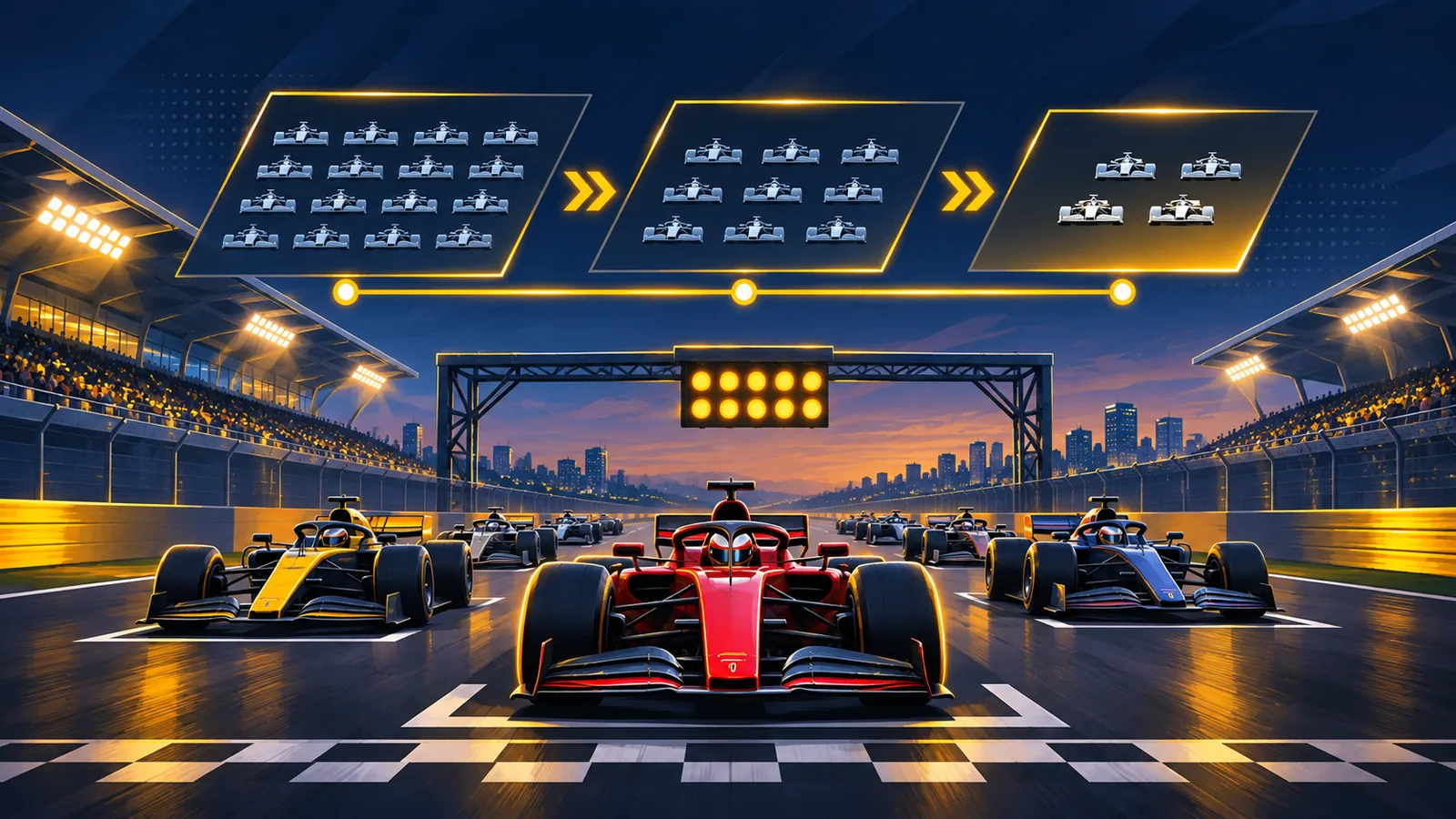
- Q1 and Q2 eliminate 6 cars each
- Post-qualifying penalties can alter the starting order
1Key Takeaways
- F1 qualifying is divided into three knockout stages—Q1, Q2, and Q3—and has been used since 2006.
- With Cadillac joining in 2026, the grid expanded to 22 cars, eliminating 6 cars each in Q1 and Q2.
- The session lengths are Q1 at 18 minutes, Q2 at 15 minutes, and Q3 at 13 minutes.
- Parc fermé takes effect from the start of qualifying; drivers who violate it must start from the pit lane.
- Drivers whose Q1 lap time exceeds 107% of the fastest lap are, in principle, not allowed to take part in the race.
- Drivers may receive grid penalties for infractions after qualifying, meaning the starting order does not necessarily match qualifying results.
2How the Three Knockout Stages Work
Qualifying is used to determine the starting order for the race and is divided into three stages: Q1, Q2, and Q3. The knockout format has been used since 2006.
With Cadillac joining in 2026, the grid expanded to 22 cars. Originally, 5 cars were eliminated in Q1 and Q2 each; now 6 cars are eliminated in each.
The length of each session and the corresponding grid positions are as follows:
| Session | Length | Outcome |
|---|---|---|
| Q1 | 18 minutes | Eliminated drivers take positions 17–22 |
| Q2 | 15 minutes | Eliminated drivers take positions 11–16; times are reset when Q2 begins |
| Q3 | 13 minutes | Decides the top 10 positions and pole position |
"Times are reset when Q2 begins" means that lap times from Q1 are not carried over into Q2, and advancing drivers must set new lap times.
3Why Q3 Has an Extra Minute
Extending Q3 from 12 minutes to 13 minutes is a change confirmed by the FIA in February 2026. The break between Q2 and Q3 was reduced by 1 minute as a result, keeping the total duration of qualifying at 1 hour.
The reason for the change was that in 2025, teams queued at the pit lane exit, leading to unsafe releases, and some drivers did not have enough time to set a final lap.
4Duration of Sprint Qualifying
Sprint qualifying is divided into SQ1, SQ2, and SQ3, with durations of 12, 10, and 8 minutes, likewise eliminating 6 cars in each stage.
5Parc Fermé: No Major Changes After Qualifying
Parc fermé takes effect starting from qualifying. After that, teams can only make very minor adjustments, and drivers who violate the rules must start from the pit lane.
6The 107% Rule
Drivers whose Q1 lap time exceeds 107% of the fastest lap cannot participate in the race. Under exceptional circumstances, such as setting a reasonable lap time in practice sessions, the stewards may permit the driver to start.
This rule was introduced in 1996 and reinstated in 2011. The 107% rule does not apply to wet-weather qualifying.
7Why Pole Position Does Not Always Start First
Grid penalties are applied after qualifying. Penalties stem from two sources:
- On-track infractions: impeding another driver's flying lap, ignoring yellow flags, or repeatedly exceeding track limits.
- Technical infringements: replacing power unit components or exceeding component allocations.
For example, if the pole position driver is penalized 5 grid spots, the drivers behind move up in order. Therefore, in addition to checking the qualifying results, one must also check the final starting grid published before the race.
8Qualifying Tyres
On a standard race weekend each driver has 13 sets of dry tyres. Drivers who reach Q3 receive one extra set of soft tyres; drivers who miss Q3 do not get that extra set.
9What to Watch for During Qualifying
- With 6 cars eliminated in both Q1 and Q2, the battle to advance among midfield teams is at its tightest.
- Times are reset in Q2, requiring advancing drivers to set new lap times.
- Q3 lasts only 13 minutes, where the timing of the final lap impacts pole position.
- If penalties are applied after the session, the starting order will differ from the qualifying results.
10Frequently Asked Questions
How many stages are there in F1 qualifying?
Three stages: Q1, Q2, and Q3. This knockout format has been used since 2006.
How many cars are eliminated in Q1 and Q2 in 2026?
6 cars are eliminated in each. After Cadillac joined, the grid expanded to 22 cars, up from 5 eliminations in each previously.
How many minutes are Q1, Q2, and Q3?
Q1 is 18 minutes, Q2 is 15 minutes, and Q3 is 13 minutes.
What is the duration of Sprint Qualifying?
SQ1 is 12 minutes, SQ2 is 10 minutes, and SQ3 is 8 minutes, likewise eliminating 6 cars in each stage.
What is the 107% rule?
Drivers whose Q1 lap time exceeds 107% of the fastest lap cannot participate in the race, though stewards may grant permission to start under exceptional circumstances. This rule does not apply to wet-weather qualifying.
11CTA
Before watching qualifying, keep in mind the rhythm of Q1 (18 minutes), Q2 (15 minutes), and Q3 (13 minutes). After the session, cross-check the final starting grid to see if any penalties were applied.
12Sources
- Formula One History
- The Race
- PlanetF1 (Q3 extra 1 minute)
- Wikipedia (107% rule)
- Autosport (107% rule reinstated in 2011)
- GPFans (Qualifying rules)
- PlanetF1 (Tyre rules)
- BBC (2026 standard weekend: 13 sets of dry tyres; Q3 drivers get an extra soft set)
- Formula 1 (2026 Australian Grand Prix: Q3 drivers get an extra soft set)

A-He
A-He is the newsroom's editor-in-chief, covering cross-sport topics, tools, rules explainers and esports. She starts with source quality and the current rulebook, then asks which numbers actually answer the reader's question, making definitions, limits and exceptions easy to compare across sports.
View profile and articles ›