 Premier League
 Champions League
 LaLiga
 Serie A
 Bundesliga
 Ligue 1
 National teams
 MLB
 CPBL
 NPB
 KBO League
 Taiwanese players abroad
 League of Legends
 VALORANT
 CS2
 Dota 2
Football Offside and VAR Explained in Plain Language: How It's Judged, When It Intervenes, and Why Goals Get DisallowedGuides · Football · Formats & rules
Key points
- Offside first considers position at the moment of the pass, then active involvement
- VAR only reviews major decisions, with the final call made by the referee
- Semi-automated offside technology assists measurement without replacing the referee
1Offside First Considers Position, Then Active Involvement
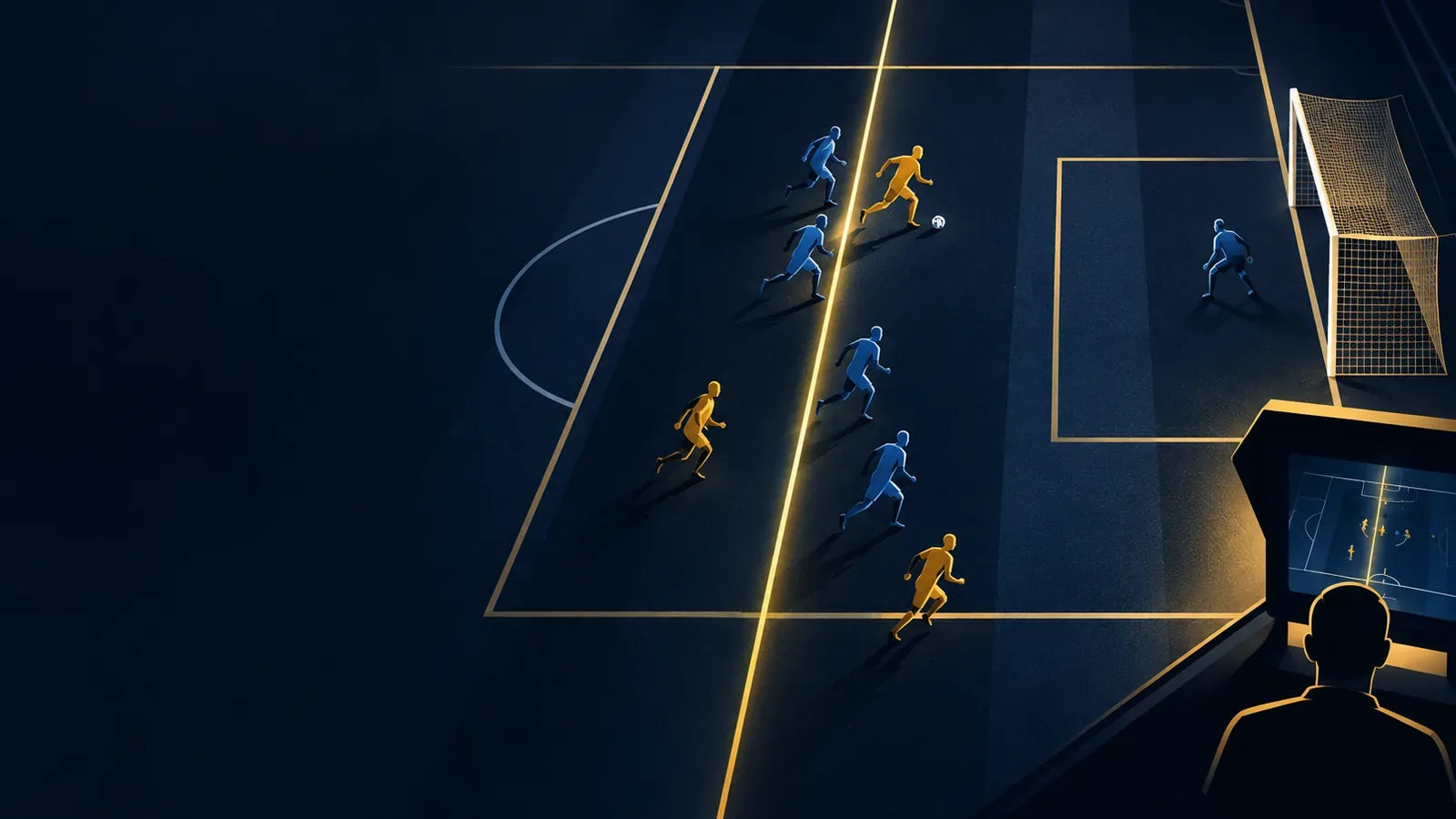
Offside in football cannot be judged simply by whether "a forward is standing behind a defender." The decision involves two steps: whether the player is in an offside position at the moment a teammate passes or touches the ball; and then, whether that player is involved in the attack. An offside offence is penalized only when the player meets the positional criteria and becomes actively involved in play in a manner defined by the Laws.
This article is compiled based on the IFAB 2026/27 Laws of the Game. When following the Premier League schedule or the Champions League schedule and waiting on VAR after a goal, ask first: which pass is being reviewed, who was in question positionally, and what that player did.
2Position Must Be Frozen at the Moment a Teammate Touches the Ball
For normal passes, judgment is made at the first point of contact when a teammate begins touching the ball, rather than waiting until the receiving player controls it. Goalkeepers throwing the ball with their hands are an exception, judged at the point of final contact before the ball leaves the hand. Therefore, a forward who makes a run in front of a defender to receive the ball after the pass was played can still be completely onside; conversely, a player who was originally offside does not automatically negate that offside simply by running back onside to receive the ball.
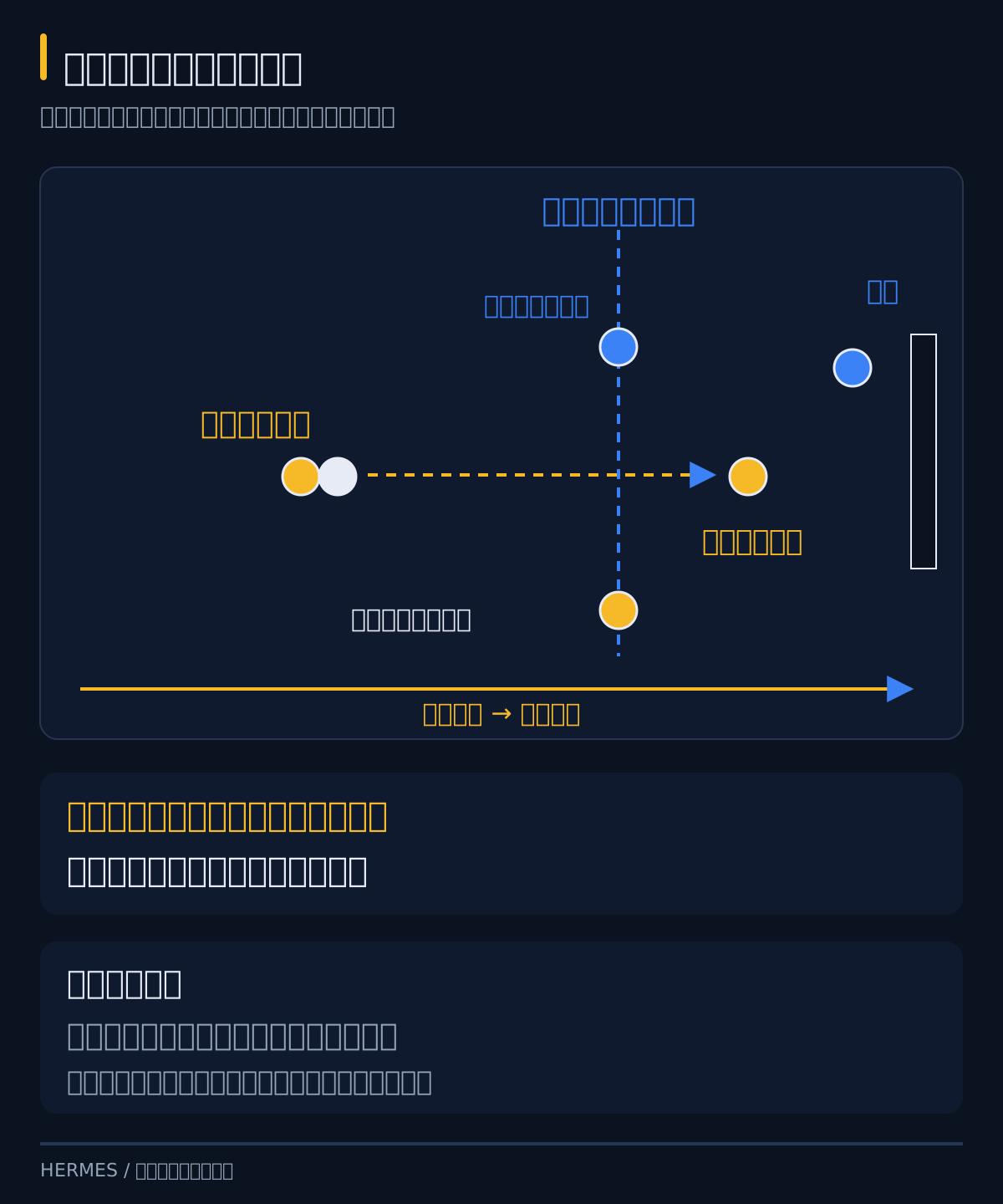
An offside position requires meeting all of the following conditions simultaneously: any part of the head, body, or feet is in the opponents' half of the pitch, and nearer to the opponents' goal line than both the ball and the second-last opponent. Hands and arms are not considered, which applies to goalkeepers as well; the upper boundary of the arm aligns with the bottom of the armpit. The halfway line itself is not considered part of the opponents' half, and being level with the second-last opponent is not an offside position.
The comparison here is with "opponents," who are not necessarily defenders, and certainly not fixed to the last defender. If the goalkeeper comes off their line, two other outfield players may form the benchmark. If the receiver is behind or level with the ball, they do not meet the conditions for an offside position even if only the goalkeeper remains ahead of them. In other words, one must be nearer to the goal line than both the ball and the second-last opponent: being ahead of the opponent without being nearer to the goal line than the ball is still not an offside position.
3Offside Can Occur Without Touching the Ball
The most straightforward scenario is receiving a teammate's pass, touching the ball, or shooting; however, active involvement in play also includes interfering with an opponent. For instance, standing in an offside position and blocking the goalkeeper's line of sight, challenging a defender for the ball, or making an obvious attempt to play a ball close by that impacts an opponent can all constitute an offence. Claiming "I didn't touch the ball" is not an automatic pass.
Another scenario is gaining an advantage from an initial offside position: after a teammate shoots, the ball rebounds off a goalpost, crossbar, or opponent and the player scores on the rebound; or the player wins the ball following a goalkeeper's save. In these situations, the assessment still traces back to the moment the teammate originally touched the ball. Conversely, a player in an offside position who is far from the path of the ball and does not interfere with an opponent will not be penalized merely for their positioning.
Suppose that when a teammate plays a pass, Player A is in an offside position while Player B is not. If Player A lets the ball run through without interfering with an opponent, Player B can receive the ball and attack; if Player A first challenges a defender for the ball, even if Player B scores, the goal may still be disallowed due to Player A's offside offence. This is a scenario deduced from the Laws.
4Situations Where Offside Does Not Apply
Below is a comparison of positional conditions alongside exceptions for restarts of play. The word "directly" in the table is crucial and does not extend indefinitely to every subsequent pass.
| Situation | Key Assessment Point |
|---|---|
| In own half or on the halfway line | If none of the body parts considered for offside have entered the opponents' half, the player is not in an offside position |
| Behind or level with the ball | Not nearer to the opponents' goal line than the ball, failing the positional criteria |
| Level with the second-last opponent | Not in an offside position |
| Receiving directly from a goal kick, throw-in, or corner kick | Does not constitute an offside offence; if a teammate plays another pass afterward, it must be reassessed |
| Receiving a ball deliberately played by an opponent | Generally not considered gaining an advantage from an offside position, except from a deliberate save |
A goal kick is a restart after the ball has gone out of play and must not be confused with a goalkeeper catching the ball in open play and kicking it out; the latter can still involve offside. A free kick also has no equivalent exemption for receiving the ball directly.
5An Opponent Touching the Ball Does Not Necessarily Reset Offside
When IFAB refers to a deliberate play, the core criterion is that the opponent has the possibility of controlling the ball—being able to pass, gain possession, or clear it. The judgment looks at whether the player had a clear view of the incoming ball, whether its speed and direction were expected, and whether there was time to coordinate body movement. Even if the clearance ultimately results in an error, it does not necessarily change its nature as a "deliberate play."
However, a ball struck from close range that suddenly hits a defender, or an instinctive stretch of the foot that merely glances the ball, may simply be a rebound or deflection. One cannot claim offside is reset merely because the ball touched an opponent. A deliberate save is also treated separately: stopping or attempting to stop a ball that is going into, or very close to, the goal qualifies as a save, and the player making this action does not have to be a goalkeeper.
6Four Core VAR Categories and New Exceptions
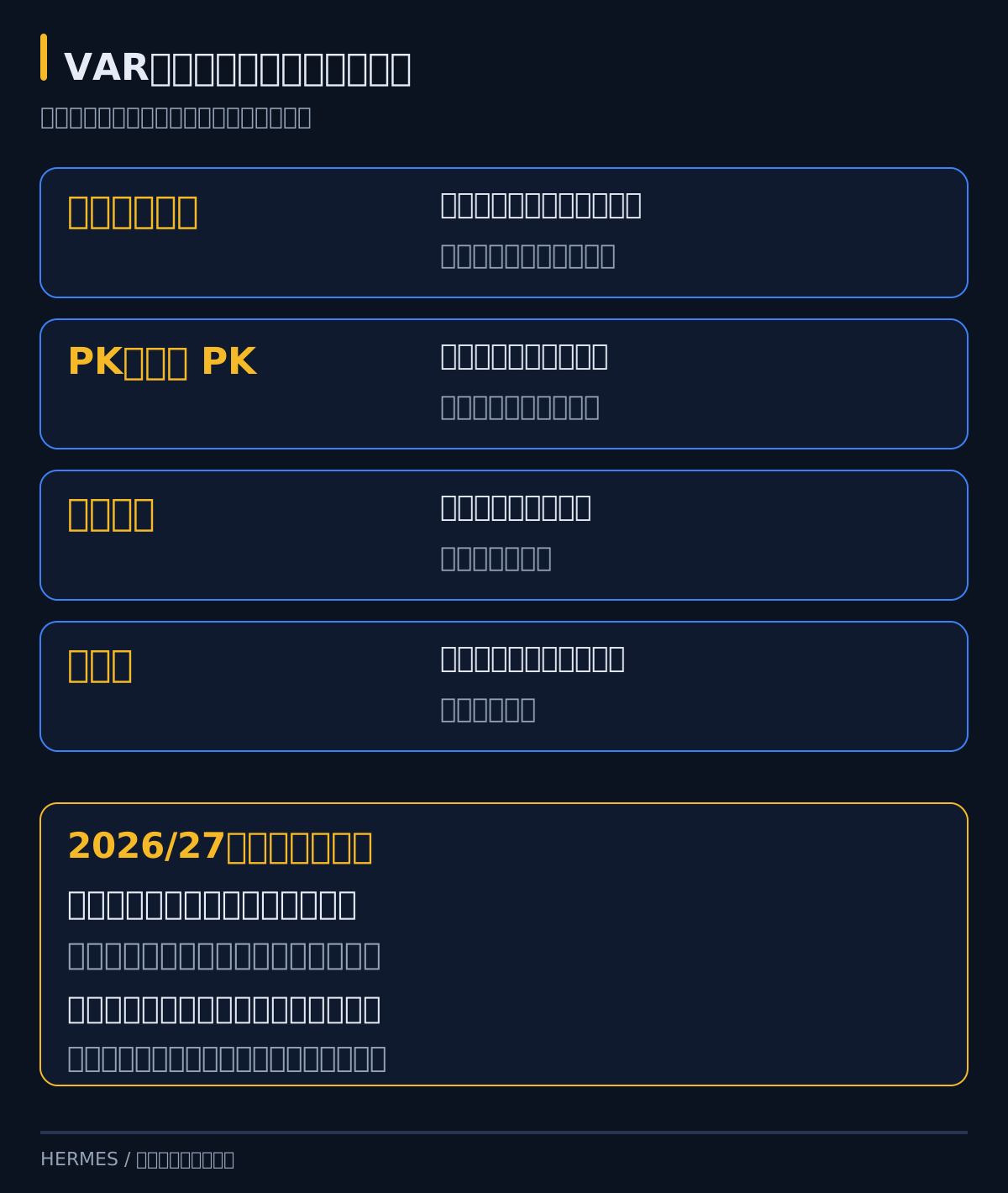
A VAR is a Video Assistant Referee who assists the referee in reviewing major decisions, while the final decision remains with the referee. The four core categories traditionally cited are as follows.
| Core Category | What Can Be Checked |
|---|---|
| Goal / no goal | Whether the ball entered the goal, and whether there was an offside, foul, handball, or ball out of play in the attacking phase |
| Penalty kick / no penalty kick | Whether a foul occurred inside the penalty area, the location of the foul, and whether the attacking phase leading up to it was legal |
| Direct red card | Whether serious foul play, violent conduct, etc. warrants a direct sending-off |
| Mistaken identity | A yellow or red card shown to the wrong player, correcting who is penalized |
However, this table must not be interpreted as meaning only four categories exist in the current Laws. The 2026/27 edition introduces a new provision: a clearly wrongly issued second yellow card leading to a red card can be reviewed; however, missing a potential second yellow card still cannot trigger an intervention. The correction of mistaken identity also covers situations where a card was issued mistakenly due to penalizing the wrong team for an offence.
In addition, competitions may choose to review clearly wrongly awarded corner kicks (including cases where the ball actually went out over the touchline but was awarded as a corner kick), but this must be corrected immediately without delaying the restart of play; if the corner kick has already been taken quickly, the decision cannot be overturned. This is a competition option, and it cannot be assumed that every league adopts it. Standard yellow cards or ordinary throw-in disputes also cannot trigger a review simply at a player's request.
7"Clear and Obvious Error" Does Not Mean Re-refereeing Every Contact
The baseline threshold for a VAR overturn is a "clear and obvious error" or a "serious missed incident." After the referee has made a decision, the footage must clearly demonstrate the error before the original decision is altered; a debate between two reasonable interpretations does not mean a decision must be overturned. VAR is not meant to re-referee every physical contact throughout the entire match.
One must also distinguish between factual and subjective decisions. Factual matters, such as offside position or whether a foul occurred inside or outside the penalty area, can usually be established by video and may be communicated directly via the headset; subjective matters, such as the intensity of a foul, handball considerations, or whether an offside player interfered with an opponent, are appropriate for an on-field review at the pitchside monitor by the referee. Not walking over to the monitor does not mean a check was not conducted.
Positional judgment also has no universal exemption where being "only slightly ahead doesn't count." Position is first confirmed according to the video and technological procedures of the specific competition, followed by assessing whether there was active involvement; do not confuse the intervention threshold for subjective fouls with offside by assuming a player must be visibly offside by a wide margin to the naked eye for it to stand.
8How Semi-Automated Offside Technology Helps
Taking the system used at the 2022 World Cup in Qatar as an example, the stadium featured 12 tracking cameras tracking up to 29 data points on each player's body 50 times per second; a sensor inside the match ball transmitted data 500 times per second to help pinpoint the exact point of contact. These were the specifications for that World Cup and do not mean all competitions use the exact same equipment.
The system combines the ball and player positions to generate an automated offside alert; video match officials must still validate the kick point and offside line before notifying the referee. Once confirmed, a 3D animation can be generated to illustrate the positioning to spectators. It is called "semi-automated" because the technology assists with measurement, while rule-based judgments—such as whether a player interfered with an opponent—still require the referee.
Different competitions do not necessarily use the same equipment, so World Cup specifications should not be assumed as universal practice. Law 5 (The Referee) of the 2026/27 IFAB Laws explicitly permits competitions to use technology to support offside decisions, known as semi-automated offside technology (SAOT); advanced versions can even transmit offside information directly to the assistant referee. Whether to implement it remains a decision for individual competition organizers.
9Real-World Example: A Goal Was Scored, but Prior Offside Must Still Be Checked
In the World Cup opening match between Qatar and Ecuador on Nov 20, 2022, an early goal by Enner Valencia was disallowed for offside following a VAR review. FIFA's match report confirmed this overturn; Valencia subsequently scored two other goals, and Ecuador ultimately won 2–0. The date here follows FIFA's match notation.
This match served as a reminder to fans: referees review the relevant attacking phase of play leading up to a goal; looking solely at the final shot might miss prior offsides, fouls, or the ball going out of play. Every goal is automatically checked, and spectators generally only notice a delay when a deeper review is required.
Assistant referees may delay raising their flag when there is a clear goalscoring opportunity, such as when a player is clean through on goal or entering the penalty area, preserving the opportunity for subsequent review. Thus, seeing the ball enter the net before a flag is raised or a call is overturned is not a contradiction. If an offside offence is confirmed, the goal is disallowed and play restarts with an indirect free kick; the fact that fans already celebrated does not nullify the original offence.
10What Other Changes Apply in 2026/27
The IFAB 2026/27 Laws of the Game took effect on July 1, 2026, and also applied to the 2026 World Cup. Regarding offside, three distinctions must be made clear:
- The offside law itself was not amended. There are no changes to Law 11 in the 2026/27 amendments published by IFAB.
- The scope of VAR expanded: The previously mentioned wrongly issued second yellow card, mistaken identity, and the competition option for corner kick reviews are all newly added in this edition.
- "Daylight offside" is only a trial, not an official law. The concept is that as long as any part of an attacking player's body that can score a goal remains level with or behind the second-last defender, the player is not offside. Under IFAB approval, FIFA began trialing this in the Canadian Premier League starting in April 2026. Until the official Laws are changed, competitions continue to judge offside according to the existing Law 11.
11Summary
Offside first freezes positioning at the moment a teammate touches the ball, then assesses whether the player touched the ball, interfered with an opponent, or gained an advantage from a rebound or save. Exceptions exist for receiving directly from a goal kick, throw-in, or corner kick, while touches by an opponent must be distinguished between deliberate play, deflections, and saves. VAR centers on major match-changing decisions, with the current Laws also including wrongly issued second yellow cards and optional corner kick reviews; semi-automated technology assists in determining positions, but the final decision still rests with the referee. When a goal is disallowed, looking for the pass being reviewed and the involved action makes it much easier to understand than simply watching the final shot.
12Frequently Asked Questions
Is "daylight offside" the current rule?
No. It is only a trial. Under IFAB approval, FIFA began trialing it in the Canadian Premier League from April 4, 2026, and the official offside text in the 2026/27 Laws has not changed. When seeing news claiming "offside is changing," first check whether it refers to a trial or something already codified into the Laws.
Does it help when a player makes the TV signal to demand a VAR check?
No, and it may result in a caution. The IFAB VAR protocol explains that VAR automatically checks every core situation, such as every goal, without needing player requests; players excessively making the TV signal will be cautioned.
Does every league have semi-automated offside technology?
Not necessarily. Law 5 merely explicitly "permits" competitions to use it and does not mandate it; whether to adopt it and how many cameras to deploy is decided by each individual competition. The offside lines viewers see may also be manually calibrated by video match officials, as both practices exist.
Was the offside law amended this year?
No. The changes in 2026/27 are concentrated on the scope of VAR reviews and the provisions for technology in Law 5; see "What Other Changes Apply in 2026/27" above for details.
13Sources
- IFAB Laws of the Game, Law 11 "Offside"
- IFAB, *Laws of the Game 2026/27 Law changes*
- IFAB, "Video Assistant Referee (VAR) Protocol"
- FIFA, "Semi-automated offside technology" (2022 World Cup)
- FIFA, "Canadian Premier League daylight offside trial" (2026-03-31)
- FIFA, "Valencia the hero as Ecuador down Qatar"

Old Parker
Old Parker covers the Premier League, Champions League, Europe's major leagues and international football. He reads matches through schedule load, home-field context and recent form, then uses the numbers to explain formats, qualification routes and viewing times for readers in Taiwan.
View profile and articles ›