 Premier League
 Champions League
 LaLiga
 Serie A
 Bundesliga
 Ligue 1
 National teams
 MLB
 CPBL
 NPB
 KBO League
 Taiwanese players abroad
 League of Legends
 VALORANT
 CS2
 Dota 2
How to Read Over/Under Totals: Football 2.5, 2.5/3, Baseball 8.5, Basketball Totals, and Taiwan Lines Like 225+50 ExplainedGuides · Odds & lines · Formats & rules

Key points
- Over/Under totals only look at the combined score of both teams
- Football lines are finely split; baseball lines hover around 9 runs
- With Taiwan lines like 225+50, outcomes that land exactly on the line settle by percentage
1What Is Over/Under: Only the Combined Score Matters
Over/Under, also called Totals, disregards who wins completely and only looks at whether the combined score of both teams is higher or lower than the line.
- Over: The total score is higher than the line.
- Under: The total score is lower than the line.
Example: Baseball Over/Under 8.5.
| Score | Total | Result |
|---|---|---|
| Team A wins 5:4 | 9 | Over |
| Team A wins 3:2 | 5 | Under |
| Team A loses 0:9 | 9 | Over |
Whether Team A wins or loses makes no difference; 5:4 and 0:9 are both Over.
There are also "Home Team Over/Under" and "Away Team Over/Under" markets that focus only on a single team. For example, if the home team total is 4.5, only the home team's own score matters: scoring 5 runs is an Over, regardless of how many the opponent scores.
The line number and the odds are two different things. When you see "Over 8.5 (1.90)", 8.5 is the line, and 1.90 is the decimal odds, where staking 100 on a winning bet returns 190. For various odds notations, see the odds formats guide.
2Football Over/Under Goals: Half-Goal, Whole-Goal, and Split Lines
Football features low scoring, often ending with only 2 or 3 goals in a match, so the lines are split very finely into three types, just like handicap betting.
Half-Goal Lines: 2.5 Is Clear-Cut
Lines with .5 cannot land exactly on the number, so they always produce a decisive Over or Under. For Over/Under 2.5:
- 0:0, 1:0, 1:1 (2 goals or fewer total) → Under
- 2:1, 3:0, 2:2 (3 goals or more total) → Over
Whole-Goal Lines: Refund if Exactly Equal
Over/Under 3:
- 3:1, 2:2 (4 goals or more) → Over wins
- 2:1, 3:0 (exactly 3 goals) → Push, stake refunded
- 1:1, 2:0 (2 goals or fewer) → Under wins
Split Lines: 2.5/3
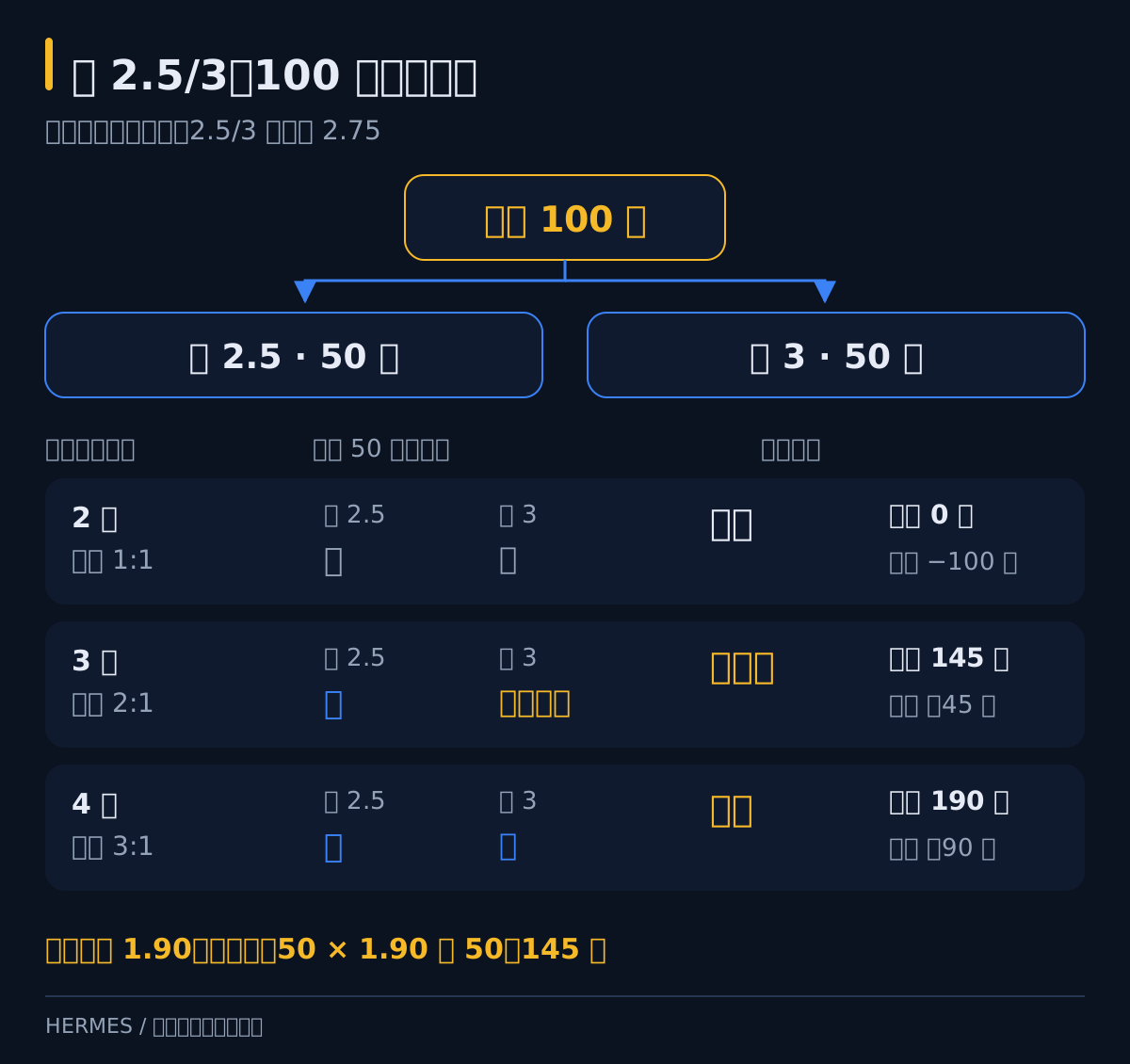
Lines written as 2.5/3 (also written as 2.75) mean splitting your money into two halves, with one half staked on 2.5 and the other half on 3.
Staking 100 on Over 2.5/3:
| Score | Total Goals | The 50 on 2.5 | The 50 on 3 | Result |
|---|---|---|---|---|
| 1:1 | 2 | Loss | Loss | Full loss |
| 2:1 | 3 | Win | Push (refunded) | Half win |
| 3:1 | 4 | Win | Win | Full win |
Betting on Under reverses the whole table: with exactly 3 goals, it is a half loss, and with 2 goals or fewer, it is a full win.
Split Lines: 2/2.5
2/2.5 (also written as 2.25) splits the bet into half on 2 and half on 2.5. If betting Over:
- 1:0 (1 goal) → Both sides lose; full loss
- 1:1 (exactly 2 goals) → The 2 half pushes, the 2.5 half loses; half loss
- 2:1 (3 goals or more) → Full win
Football Over/Under Reference Table
From the perspective of betting Over:
| Line | Also Written As | Full Win | Exactly on the Line | Full Loss |
|---|---|---|---|---|
| 2 | 2.0 | 3 goals or more | 2 goals: refund stake | 1 goal or fewer |
| 2/2.5 | 2.25 | 3 goals or more | 2 goals: half loss | 1 goal or fewer |
| 2.5 | 2.5 | 3 goals or more | No push line | 2 goals or fewer |
| 2.5/3 | 2.75 | 4 goals or more | 3 goals: half win | 2 goals or fewer |
| 3 | 3.0 | 4 goals or more | 3 goals: refund stake | 2 goals or fewer |
| 3/3.5 | 3.25 | 4 goals or more | 3 goals: half loss | 2 goals or fewer |
| 3.5 | 3.5 | 4 goals or more | No push line | 3 goals or fewer |
If betting Under, "half win" and "half loss" are swapped, and the rest is read in reverse.
How Much Do You Actually Get Back on a Half Win?
Staking 100 at decimal odds of 1.90:
| Result | Return | Net Profit |
|---|---|---|
| Full win | 190 | +90 |
| Half win | 50 × 1.90 + 50 = 145 | +45 |
| Push | 100 | 0 |
| Half loss | 50 | -50 |
| Full loss | 0 | -100 |
A half win means "half the money wins according to the odds, and the other half is refunded," so the net profit is exactly half of a full win.
Only 90 Minutes Count
Full-time football Over/Under only counts 90 minutes plus stoppage time; extra time and penalty shootouts do not count, which is also how Taiwan Sports Lottery's betting regulations specify it.
Example: In a cup tournament, a match is 1:1 at 90 minutes and finishes 2:1 in extra time. Over/Under 2.5 settles based on the 2 goals from 1:1, meaning Under wins. Even if the subsequent penalty shootout reaches 5:4, none of those goals count.
First-half Over/Under only considers the first half's 45 minutes plus stoppage time, and the line is usually much lower than full-time, such as 1 or 1.5. If the first half ends 1:0 and 3 more goals are scored in the second half, a first-half Over/Under 1.5 is still Under.
3Baseball Over/Under: Lines Adjust with Starting Pitchers
In 2026, MLB teams averaged 4.48 runs per game, meaning both teams combined for about 9 runs. Consequently, baseball Over/Under lines typically hover around 9 runs. When ace starting pitchers face each other, lines open lower; if both pitchers are shaky, lines get pushed upward.
Over/Under 8.5:
| Score | Total | Result |
|---|---|---|
| 5:3 | 8 | Under |
| 6:3 | 9 | Over |
| 2:1 | 3 | Under |
| 10:7 | 17 | Over |
Whether Extra Innings Count Depends on Betting Rules
Whether baseball full-game totals include extra innings, and how games that do not finish 9 full innings (such as ending after 8.5 innings when the home team leads) are settled, depends on the betting rules announced by Taiwan Sports Lottery. You should review them carefully before placing a bet.
Example (assuming the bet type includes extra innings in the total): With an Over/Under of 7.5, the score is 3:3 (6 runs) after 9 innings, which initially looked like a safe win for Under. However, Team A scores 2 runs in the 10th inning to end the game at 5:3, bringing the total to 8 and turning it into an Over.
In MLB regular-season extra innings, every half-inning starts with a runner on second base (this rule does not apply in the postseason), making it easier to score runs. Therefore, whether extra innings are counted directly impacts the Over/Under outcome.
Some bet types only cover the total for the first few innings (such as the first 5 innings), and their names and rules are likewise subject to Taiwan Sports Lottery announcements; betting only on the first few innings avoids any impact from extra innings.
4Basketball Over/Under: Lines in the 220s Are Common
Basketball features high scoring. In the 2025-26 NBA season, teams averaged 115.6 points per game, combining for roughly 231 points.
Over/Under 228.5:
| Score | Total | Result |
|---|---|---|
| 115:110 | 225 | Under |
| 120:112 | 232 | Over |
| 98:95 | 193 | Under |
Different teams vary substantially. In that same season, the Nuggets averaged 122.1 points scored and 116.9 allowed per game, for an average total of about 239. The Celtics averaged 114.9 points scored and 107.2 allowed, for about 222. Even within the same NBA, it is completely normal for total lines between different teams to differ by more than 15 points.
Whether Overtime Counts Depends on Betting Rules
Whether full-game basketball Over/Under includes overtime depends on the betting rules announced by Taiwan Sports Lottery; do not simply apply football's "only 90 minutes count" rule.
Example (assuming the bet type includes overtime in the total): With an Over/Under of 225.5, the score is 110:110 (220 points) after 4 quarters, putting the Under ahead. The game ends 118:114 after overtime, totaling 232 points and turning it into an Over. Based on the season's average pace, a 5-minute overtime period adds roughly 24 points combined for both teams (231 ÷ 48 × 5). Therefore, if overtime counts, going to overtime from a tie is generally favorable for the Over.
Half-time and single-quarter totals only cover their respective periods; overtime is not included.
5Over/Under Paired with Point Spread: Reverse-Engineering Each Team's Projected Score
Examining the Over/Under and point spread together allows you to reverse-engineer how many points the market expects each team to score:
- Favorite's projected score = (Total line + Spread) ÷ 2
- Underdog's projected score = (Total line - Spread) ÷ 2
Example: In an NBA game, Team A is favored by 5.5 points, and the Over/Under is 225.5.
- Team A: (225.5 + 5.5) ÷ 2 = 115.5 points
- Team B: (225.5 - 5.5) ÷ 2 = 110 points
The two teams combine for 225.5 and have a 5.5 difference, matching both lines exactly. This method works best in basketball. In baseball, the run line is almost always fixed at 1.5 with odds adjustments instead, so reverse-engineered margins are less accurate.
These figures can be compared with each team's actual points scored and allowed per game to see whether the line is set high or low.
| Metric | Team A | Team B |
|---|---|---|
| Implied score from lines | 115.5 | 110 |
| Season average points scored | 118.0 | 112.5 |
| Season average points allowed | 111.0 | 116.0 |
The table above is illustrative: Team A's offense scores 2.5 points more than implied, and Team B's defense is poor, with both teams' numbers pointing toward a higher total.
6Taiwan Lines: What Does Over/Under 225+50 Mean?
In Taiwan's local betting markets, Over/Under lines use the same notation as handicaps like 1+70: 225+50, 8-30, 9+25.
The logic is completely identical: when the total score lands exactly on the line, a percentage determines how much you win or lose, and the + and - signs are viewed from the perspective of the "Over":
- + sign: If the score lands exactly on the line, Over bets win that percentage, and Under bets lose that percentage.
- - sign: If the score lands exactly on the line, Over bets lose that percentage, and Under bets win that percentage.
- Higher than the line: Over wins in full. Lower than the line: Under wins in full.
The winning side receives stake multiplied by odds multiplied by the percentage; the losing side simply loses stake multiplied by the percentage. Taiwan lines most commonly quote odds of 0.95 (Hong Kong style), meaning a full win nets 95% of the stake.
Example: Basketball Over/Under 225+50
Staking 1000 at odds of 0.95:
| Total Score | Bet Over | Bet Under |
|---|---|---|
| 226 or higher | Full win +950 | Full loss -1000 |
| Exactly 225 | Win 50%: 1000 × 0.95 × 50% = +475 | Lose 50%: -500 |
| 224 or lower | Full loss -1000 | Full win +950 |
A score of 113:112 is exactly 225 points; Over bets net 475, and Under bets lose 500.
Example: Baseball Over/Under 8-30
Likewise staking 1000 at odds of 0.95:
| Total Score | Bet Over | Bet Under |
|---|---|---|
| 9 or higher | Full win +950 | Full loss -1000 |
| Exactly 8 | Lose 30%: -300 | Win 30%: 1000 × 0.95 × 30% = +285 |
| 7 or lower | Full loss -1000 | Full win +950 |
A score of 5:3 is exactly 8 runs; Over bets lose 300, and Under bets net 285.
Comparison with International Notations
| Taiwan Line | Betting Over with Exactly 8 Runs | Closest Equivalent International Line |
|---|---|---|
| 8+50 | Half win | Over 7.5/8 (7.75) |
| 8 | Push (stake refunded) | Over 8 |
| 8-50 | Half loss | Over 8/8.5 (8.25) |
The further the percentage moves toward +, the more the bookmaker anticipates an Over; the further toward -, the more they anticipate an Under. Bookmakers do not need to constantly adjust the base line number—adjusting the trailing percentage balances both sides.
Official Taiwan Sports Lottery Over/Under examples use lines with .5 such as "Over 2.5" paired with decimal odds; "+50" is a local colloquial Taiwan line format without a standardized rule document. Actual bet types and rules are subject to Taiwan Sports Lottery announcements.
7Frequently Asked Questions
Are Over/Under 2.5/3 and 2.75 the Same?
Yes, they are identical, just written differently. Asian markets typically write 2.5/3, while international websites often write 2.75.
How Are Football Over/Under Goals Settled if the Match Goes to Extra Time?
Only 90 minutes plus stoppage time count. Goals scored in extra time and penalty shootouts are entirely excluded.
Does Overtime Count for Both Baseball and Basketball?
It depends on the betting rules, subject to Taiwan Sports Lottery announcements. If a bet type includes extra periods in the full-game total, baseball extra innings and basketball overtime scoring will be added to the total; totals covering only the first few innings, halves, or single quarters are not affected by extra time.
Are Over/Under and Odd/Even the Same Bet Type?
No. Both look at the total score, but Odd/Even only checks whether the total is an odd or even number. A 5:4 score totaling 9 is Odd, and a 3:3 score totaling 6 is Even, completely independent of the line's value.
How Can You Estimate Over/Under Totals Yourself?
For football, you can enter both teams' expected goals into the Poisson score probability calculator and sum the probabilities of scorelines with 3 or more total goals to find the probability of Over 2.5. Then, use the implied probability calculator to convert the bookmaker's odds into probabilities for comparison. Team average goals/runs/points scored and allowed can be found on the Premier League, MLB, and NBA pages.
8Sources
- Wikipedia: Spread betting (Bets on the total)
- TVBS (2026-07-19): 2026 World Cup Sports Lottery Betting Guide
- NOWnews (2026-07-06): World Cup Sports Lottery Rules Too Difficult to Understand
- Baseball-Reference: 2026 MLB League Overview
- Basketball-Reference: 2025-26 NBA Season Summary
- Wikipedia: Extra innings

A-He
A-He is the newsroom's editor-in-chief, covering cross-sport topics, tools, rules explainers and esports. She starts with source quality and the current rulebook, then asks which numbers actually answer the reader's question, making definitions, limits and exceptions easy to compare across sports.
View profile and articles ›