 Premier League
 Champions League
 LaLiga
 Serie A
 Bundesliga
 Ligue 1
 National teams
 MLB
 CPBL
 NPB
 KBO League
 Taiwanese players abroad
 League of Legends
 VALORANT
 CS2
 Dota 2
How to Read Handicap Bets? Understand Soccer Goal and a Half / Two Goals, Baseball -1.5, and Taiwan Line 1+70 All at OnceGuides · Odds & lines · Formats & rules

Key points
- Handicapping subtracts the strong team's score first before seeing who wins
- Soccer moves in 0.25-goal increments, while baseball commonly features ±1.5
- When the Taiwan line ties the handicap exactly, settlement uses percentages
1What Is a Handicap: First Add and Subtract the Scores
When the gap in strength between two teams is too large, simply guessing who wins lacks suspense, so the strong team must "give a handicap": first subtract several points from the strong team's score, and then see who wins.
- Handicap giver: The stronger team, written as a negative number, such as -1.5.
- Handicap receiver: The weaker team, written as a positive number, such as +1.5.
The calculation always has only one step: Strong team's score - handicap points, then compare with the opponent.
Example: Team A gives 1.5 points and wins the match 3:1. 3 - 1.5 = 1.5, which is still greater than 1, so bets on A are counted as wins. If it only wins 2:1, 2 - 1.5 = 0.5, which is less than 1, so bets on A lose.
The handicap points and the odds are two different things. It is common to see "A -1.5 (+150)"; -1.5 is the handicap, and +150 is the price. To understand how to read prices, you can read the Odds Formats Tutorial.
2Soccer Asian Handicap: 0.25 Jumps
Soccer has few goals and often ends 1:0, so handicaps are sliced very finely, with each 0.25 goal being one tier, known as the Asian Handicap. The Chinese names are fixed; once you understand the three types, you understand them all:
Half-Goal Lines: Either Win or Lose
Handicaps with half goals like 0.5, 1.5, and 2.5: because goals cannot come in halves, the outcome definitely decides a winner or loser, and there are no refunds.
- Half goal (0.5): Team A only needs to win to be considered a win; a draw is considered a loss.
- Goal and a half (1.5): Team A must win by 2 goals or more; winning by only 1 goal is considered a loss.
Integer Lines: Refund If It Ties Exactly
Integer handicaps like 1 goal or 2 goals: if it ends up tied after the subtraction, the principal is fully refunded, known as a "push."
- One goal (1): Team A wins by 2 goals or more to win; winning by exactly 1 goal refunds the stake; a draw or loss results in a loss.
Two Lines Combined: Lines Like 1.5/2
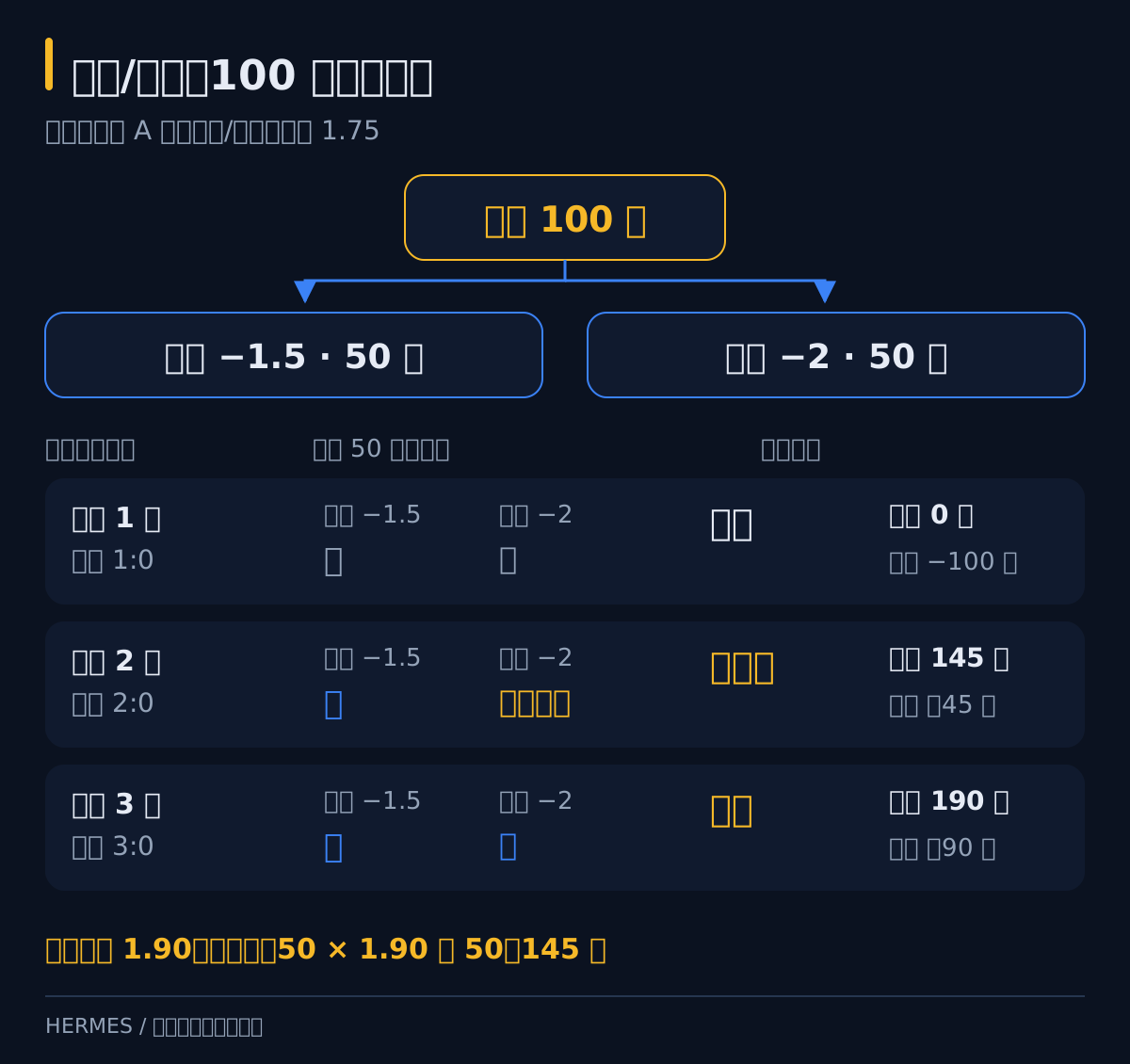
What is written as "goal and a half / two goals (1.5/2)" means splitting the money into two halves, with one half betting on a goal and a half and the other half betting on two goals. Sometimes it is also written as 1.75.
Taking Team A giving a goal and a half / two goals and staking 100 dollars as an example:
- Team A wins 3:0 (goal difference of 3): goal and a half wins, two goals also wins → Full win
- Team A wins 2:0 (goal difference of 2): the 50 on goal and a half wins, the 50 on two goals pushes and is refunded → Win half
- Team A wins 1:0 (goal difference of 1): neither side is enough → Full loss
By the same logic, when "level ball / half goal (0/0.5)" results in a draw, the half on 0 refunds, and the half on 0.5 loses, which is losing half.
Complete Comparison Table of Lines
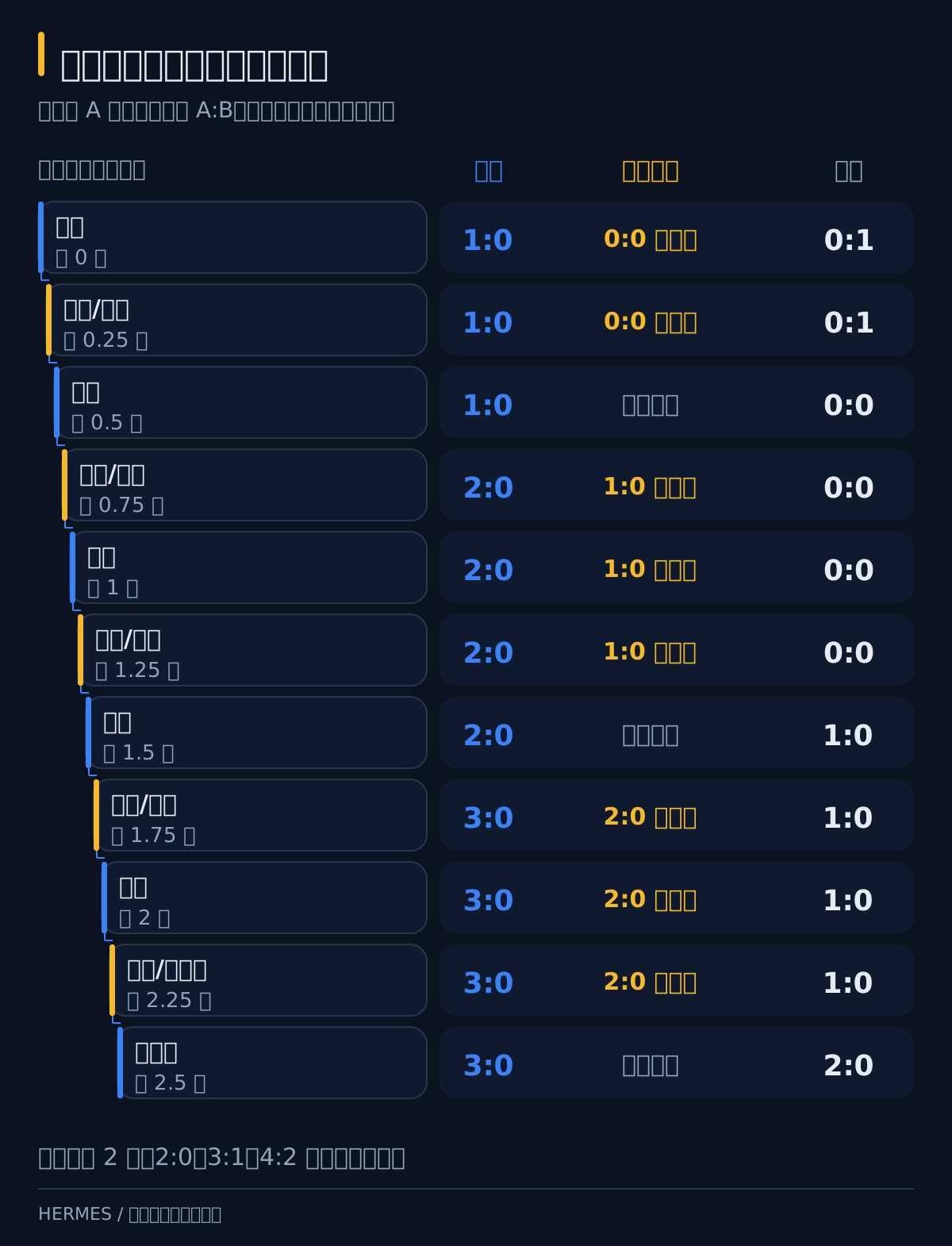
The following are all from the perspective of the handicap-giving Team A, with scores written as A:B.
| Line Name | Also Written As | Full Win | Right on the Boundary | Full Loss |
|---|---|---|---|---|
| Level ball | 0 | 1:0 | 0:0 Stake refunded | 0:1 |
| Level ball / half goal | 0/0.5, 0.25 | 1:0 | 0:0 Lose half | 0:1 |
| Half goal | 0.5 | 1:0 | No boundary | 0:0 |
| Half goal / one goal | 0.5/1, 0.75 | 2:0 | 1:0 Win half | 0:0 |
| One goal | 1 | 2:0 | 1:0 Stake refunded | 0:0 |
| One goal / goal and a half | 1/1.5, 1.25 | 2:0 | 1:0 Lose half | 0:0 |
| Goal and a half | 1.5 | 2:0 | No boundary | 1:0 |
| Goal and a half / two goals | 1.5/2, 1.75 | 3:0 | 2:0 Win half | 1:0 |
| Two goals | 2 | 3:0 | 2:0 Stake refunded | 1:0 |
| Two goals / two and a half goals | 2/2.5, 2.25 | 3:0 | 2:0 Lose half | 1:0 |
| Two and a half goals | 2.5 | 3:0 | No boundary | 2:0 |
What matters is the goal difference, not the score itself. 2:0, 3:1, and 4:2 are all a goal difference of 2, producing the same result.
For underdog B, view the entire table in reverse. When Team A gives a goal and a half / two goals and wins 2:0, Team A wins half, and those betting on B lose half.
How Much Do You Actually Get Back for "Winning Half"
Staking 100 dollars, Hong Kong odds 0.90 (European odds 1.90):
| Result | Return | Net Profit |
|---|---|---|
| Full win | 190 | +90 |
| Win half | 50 × 1.90 + 50 = 145 | +45 |
| Push | 100 | 0 |
| Lose half | 50 | -50 |
| Full loss | 0 | -100 |
Winning half means "half of the money wins according to the odds, and the other half is refunded," not getting an extra 50%.
Counted Up to Which Minute?
Soccer handicaps generally only count the 90 minutes plus injury time; extra time and penalty shootouts are not counted. In cup competitions, if a match tied 1:1 goes into extra time and ends in a 2:1 win, the handicap is settled based on 1:1.
3Baseball Handicaps: MLB's -1.5
Internationally, the most common baseball handicap is ±1.5, known in English as the Run Line; baseball handicaps in Taiwan Sports Lottery also use this half-point format.
Team A gives 1.5 runs:
- Team A wins 5:3 (wins by 2 runs) → Bets on A win
- Team A wins 4:3 (wins by only 1 run) → Bets on A lose, bets on B win
- Team A loses → Bets on A lose
One-run games are quite common in baseball, so -1.5 is actually not easy for favorites to cover. For the same favorite team, if the moneyline price is -200, after switching to giving 1.5 runs the price might become around +120 (illustrative numbers; actual values depend on the odds offered by each bookmaker).
4Taiwan Line: What Does Giving 1 Run +70 Mean?
The Taiwan line is a popular handicapping notation that circulates privately, looking like this: 1+70, 1-50, 2+30. It is not the official notation of the Taiwan Sports Lottery, nor is there a unified rules document; below is the common calculation method.
Its logic is: When the handicap giver wins by exactly the handicap amount, a percentage determines how much is won or lost.
- Number in front: How many points/runs are given.
- + sign: When winning by exactly this much, people betting on the handicap giver win this percentage.
- - sign: When winning by exactly this much, people betting on the handicap giver lose this percentage.
- No sign (only written as 1): When winning by exactly this much, the principal is refunded, just like a soccer one-goal line.
For those betting on the handicap receiver, it is the exact opposite. Taiwan line odds are most commonly quoted as 0.95, meaning when winning, you net 95% of the stake.
Example: Giving 1 Run +70
Team A gives 1 run +70, staking 1000 dollars, odds 0.95:
| Match Result | Bet on A (Handicap Giver) | Bet on B (Handicap Receiver) |
|---|---|---|
| A wins by 2 runs or more | Full win +950 | Full loss -1000 |
| A wins by exactly 1 run | Win 70%: 1000 × 0.95 × 70% = +665 | Lose 70%: -700 |
| A loses | Full loss -1000 | Full win +950 |
Example: Giving 1 Run -50
Similarly staking 1000 dollars, odds 0.95:
| Match Result | Bet on A (Handicap Giver) | Bet on B (Handicap Receiver) |
|---|---|---|
| A wins by 2 runs or more | Full win +950 | Full loss -1000 |
| A wins by exactly 1 run | Lose 50%: -500 | Win 50%: 1000 × 0.95 × 50% = +475 |
| A loses | Full loss -1000 | Full win +950 |
Why Is It Written This Way?
Replacing -1.5 with 1+70, the difference lies entirely in the cell for "winning by exactly 1 run":
- -1.5: Winning by exactly 1 run, those betting on the strong team lose everything.
- 1+70: Winning by exactly 1 run, those betting on the strong team can still win 7 tenths.
- 1-50: Winning by exactly 1 run, those betting on the strong team lose half.
The oddsmakers do not need to constantly change odds; by merely adjusting the trailing percentage, they can balance both sides to roughly equal. The more the percentage moves toward +, the more favorable the outlook is on the strong team; the more it moves toward -, the dimmer the outlook on the strong team.
Note that whether "win 70%" multiplies the odds again varies by bookmaker: the table above shows the method where it is multiplied by odds, while some calculate it directly as 70% of the stake. When encountering the Taiwan line, first clearly check the settlement rules written there.
5Basketball Handicaps: Looking at the Final Point Differential
Basketball has higher scores, and handicaps often reach 5.5 or 10.5, called Point Spread in English; the calculation is the same as above.
Team A gives 5.5 points:
- Team A wins 106:100 (wins by 6 points) → Bets on A win
- Team A wins 105:100 (wins by 5 points) → Bets on A lose
Whether overtime is counted in basketball handicaps is subject to the play rules announced by Taiwan Sports Lottery; do not directly apply soccer's "only counts 90 minutes" rule. The Taiwan line for basketball is written as 5+50 or 6-30, with the same logic as above.
6Frequently Asked Questions
Is Goal and a Half / Two Goals the Same as 1.75?
They are the same, just written differently. Many foreign websites write -1.75, while in Asia it is customarily written as 1.5/2.
Why Are Stakes Sometimes Refunded and Sometimes Not?
It depends on whether the line has a half goal/point. Those with .5 will definitely decide a win or loss; only integer lines or two combined lines can result in half refunds or full refunds.
Does Taiwan Sports Lottery Have 1+70?
No. Baseball handicaps in Taiwan Sports Lottery use half-run formats like 1.5 paired with European decimal odds; soccer handicaps are 3-way markets like "handicap 1 goal," which besides the two teams also includes a "Draw 0:1" option (if the strong team wins by exactly 1 goal, it counts as Draw 0:1), rather than an Asian handicap format. 1+70 is a Taiwan line notation circulating privately. The actual gameplay is subject to the rules announced by Taiwan Sports Lottery.
Is the Handicap Related to Win Rate?
The handicap is the market's estimate of the gap between the two teams. If you want to estimate it from data yourself, you can use the Poisson Score Probability Calculator to calculate probabilities for various scores, then check against the handicap to see if it is reasonable. For price conversion, you can use the Odds Format Converter. For gameplay that looks only at the combined total points of both teams, you can consult the Over/Under Totals Tutorial.
7Sources

A-He
A-He is the newsroom's editor-in-chief, covering cross-sport topics, tools, rules explainers and esports. She starts with source quality and the current rulebook, then asks which numbers actually answer the reader's question, making definitions, limits and exceptions easy to compare across sports.
View profile and articles ›