 Premier League
 Champions League
 LaLiga
 Serie A
 Bundesliga
 Ligue 1
 National teams
 MLB
 CPBL
 NPB
 KBO League
 Taiwanese players abroad
 League of Legends
 VALORANT
 CS2
 Dota 2
Odds formats explained: American, decimal, fractional and Hong Kong oddsGuides · Odds & lines · Formats & rules

Key points
- American, decimal, fractional and Hong Kong odds describe the same price
- Convert through decimal odds to avoid mistakes
- Implied probability equals 1 divided by decimal odds
1One idea first: every format describes the same price
An MLB broadcast may show +150 or -150. A Premier League article may quote 2.50. British racing coverage may use 3/2 instead. These are not different kinds of bet. They are different ways to display the same price, much as 1 metre and 100 centimetres describe the same length.
Every example in this guide starts with a stake of 100. Keep two terms separate:
- Profit: the extra money you win.
- Total return: everything paid back to you, meaning your stake plus the profit.
Stake 100 and receive 250, and your profit is 150. The formats differ only in whether they quote profit or total return, and whether they use a sign, decimal or fraction.
2American odds: read positive and negative prices differently
American sports use this format most often, so it is standard in MLB and NBA coverage. It is also called moneyline odds.
Positive odds: the profit on a stake of 100
+150 means a stake of 100 produces 150 in profit and a total return of 250. +200 means a stake of 100 produces 200 in profit and a total return of 300.
The larger the positive number, the more the market sees that side as an underdog, and the greater the potential profit.
Negative odds: the stake required to win 100
-150 means you must stake 150 to make 100 in profit, for a total return of 250. -200 means you must stake 200 to make 100 in profit.
Put another way, on a stake of 100, -150 returns 66.67 in profit and -200 returns 50. The minus sign does not mean you lose money. It marks the favourite, whose price offers less profit.
A useful shortcut
+100 and -100 mean the same thing: stake 100 to win 100. That is why valid American odds do not fall between -100 and +100; +50, for example, is not a valid American quote.
3Decimal odds: multiply once to get the total return
Decimal odds are common in Europe and Australia, and they are also the official format used by Taiwan Sports Lottery. The arithmetic is direct:
Total return = stake × odds
- At 2.50, a stake of 100 returns 250, including 150 in profit.
- At 1.50, a stake of 100 returns 150, including 50 in profit.
A common mistake is to read 2.50 as “a profit of 2.5 times the stake.” The 2.50 already includes the stake; the profit is 1.5 times the stake.
4Fractional odds: the fraction is the profit ratio
This is the traditional format in Britain and Ireland and remains especially common in horse racing. The number before the slash is the profit; the number after it is the required stake.
- 3/2: win 3 for every 2 staked. A stake of 100 makes 150 in profit and returns 250.
- 1/2: win 1 for every 2 staked. A stake of 100 makes 50 in profit and returns 150.
- 2/1: win 2 for every 1 staked, spoken as “two to one.”
- 1/1: win the same amount as the stake, known in Britain as “evens.”
5Hong Kong odds: a decimal that quotes profit only
Hong Kong odds appear in Asian betting markets. They look like decimal odds, but the stake is not included:
- Hong Kong 0.95: stake 100 to make 95 in profit. That equals decimal 1.95.
- Hong Kong 1.50: stake 100 to make 150 in profit. That equals decimal 2.50.
So the same displayed figure, 1.50, means a profit of 50 in decimal format but 150 in Hong Kong format—a full stake's difference. Whenever you see decimal-looking odds, first establish which system is being used.
Remember one rule: Hong Kong odds plus 1 equals decimal odds.
Indonesian and Malay odds
Asian price boards may also show Indonesian odds and Malay odds:
- Indonesian odds can be treated as American odds divided by 100. +1.50 equals American +150, while -2.00 equals American -200.
- Malay odds run from -1 to +1. A positive quote works like Hong Kong odds (+0.50 equals Hong Kong 0.50). A negative quote tells you how much must be staked to win 1: -0.50 means stake 0.5 to win 1, equivalent to decimal 3.00.
Most readers in Taiwan will rarely need either format, but it helps to recognise them.
6Conversion table
| American | Decimal | Fractional | Hong Kong | Implied probability |
|---|---|---|---|---|
| -300 | 1.33 | 1/3 | 0.33 | 75% |
| -200 | 1.50 | 1/2 | 0.50 | 66.7% |
| -150 | 1.67 | 2/3 | 0.67 | 60% |
| -110 | 1.91 | 10/11 | 0.91 | 52.4% |
| +100 | 2.00 | 1/1 | 1.00 | 50% |
| +150 | 2.50 | 3/2 | 1.50 | 40% |
| +200 | 3.00 | 2/1 | 2.00 | 33.3% |
| +300 | 4.00 | 3/1 | 3.00 | 25% |
Conversion formulas
The safest route is to convert a price to decimal first, then convert it into the format you need:
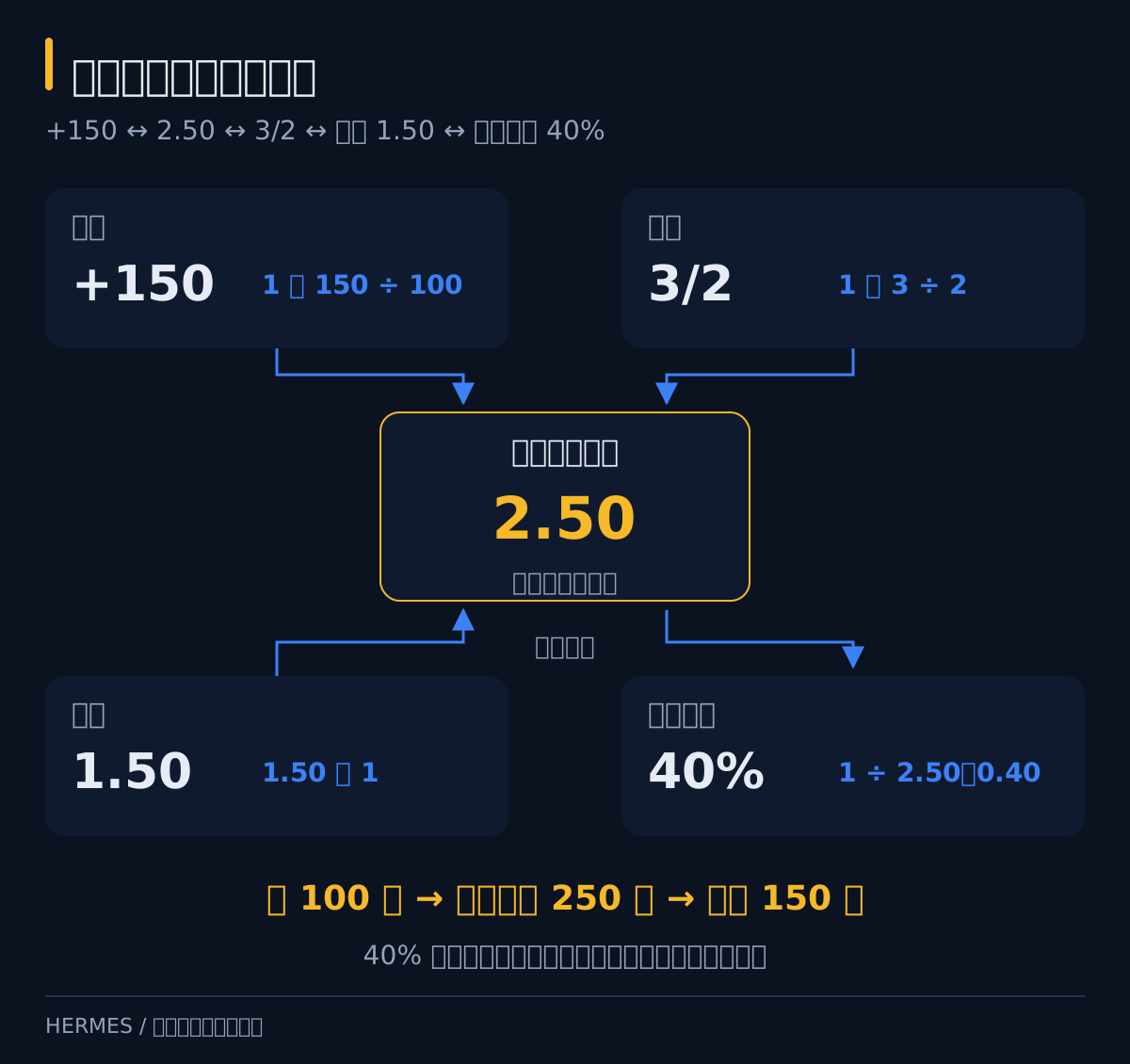
- Positive American → decimal: 1 + American ÷ 100. Thus +150 → 1 + 1.5 = 2.50.
- Negative American → decimal: 1 + 100 ÷ the American number without its minus sign. Thus -150 → 1 + 100 ÷ 150 = 1.67.
- Fractional → decimal: 1 + numerator ÷ denominator. Thus 3/2 → 1 + 1.5 = 2.50.
- Hong Kong → decimal: add 1. Thus 0.95 → 1.95.
- Decimal → American: at 2.00 or above, use (decimal - 1) × 100, so 2.50 → +150. Below 2.00, use -100 ÷ (decimal - 1), so 1.50 → -200.
If you would rather skip the arithmetic, enter any format in the odds converter to see every equivalent price.
7Implied probability: the chance hidden inside a price
Every price can be turned into the probability implied by the market:
Implied probability = 1 ÷ decimal odds
- 2.50 → 1 ÷ 2.50 = 40%
- 1.50 → 1 ÷ 1.50 = 66.7%
That makes headlines easier to read. If a report calls a team a “-200 favourite,” the market is assigning it roughly a 67% chance of winning—much more intuitive than the original quote.
This is still a probability inferred from a price, not the team's true chance of winning. To build a data-based estimate of your own, try the Poisson score probability calculator and compare its result with the market's implied probability.
8Overround: why the probabilities exceed 100%
Add the implied probabilities for every possible outcome and the total will usually be above 100%.
A standard NBA spread, for example, may price both sides at American -110, or about decimal 1.91:
- Each side: 110 ÷ 210 = 52.4%
- Both sides together: 104.8%
The extra 4.8% is the overround, the margin built into the bookmaker's market. The true probabilities of the two outcomes must sum to 100%; everything above that is the cushion in the quoted prices.
Be careful with the interpretation. An overround of 4.8% does not mean “4.8 is taken from every 100 staked.” Using the precise total of 104.76%, the average cost per 100 is 1 - 1 ÷ 1.0476 ≈ 4.5, or about 4.5.
Remove the margin to estimate fair probabilities
The simplest method is to scale every implied probability back down so the total becomes 100%:
Fair probability = outcome's implied probability ÷ sum of all implied probabilities
Consider a football three-way market priced at home 2.00, draw 3.40 and away 3.80.
- Implied probabilities: 50% + 29.4% + 26.3% = 105.7%
- After removing the margin: home 47.3%, draw 27.8%, away 24.9%
Those adjusted figures are a better picture of the market's underlying view. The lower half of the converter accepts either two or three prices and calculates both the overround and the fair probabilities.
9FAQ
Is -150 better value than 1.67?
Neither. They are the same price in different formats: -150 converts to decimal 1.67.
Why are Hong Kong odds exactly 1 lower than decimal odds?
Decimal odds quote the total return, including the stake. Hong Kong odds quote profit alone.
Can implied probability be used as a prediction?
It is a useful reference, but it includes the bookmaker's margin and reflects the market's opinion rather than a guaranteed truth. Remove the margin before making the comparison.
Are a -1.5 handicap and American odds of -150 the same thing?
No. -1.5 is the handicap line; -150 is the price, and the two often appear together. See the handicap betting guide for settlement rules, or the totals guide for markets based only on the two teams' combined score.
10Sources

A-He
A-He is the newsroom's editor-in-chief, covering cross-sport topics, tools, rules explainers and esports. She starts with source quality and the current rulebook, then asks which numbers actually answer the reader's question, making definitions, limits and exceptions easy to compare across sports.
View profile and articles ›