 Premier League
 Champions League
 LaLiga
 Serie A
 Bundesliga
 Ligue 1
 National teams
 MLB
 CPBL
 NPB
 KBO League
 Taiwanese players abroad
 League of Legends
 VALORANT
 CS2
 Dota 2
2026-27 MLB Posting System and Free Agency: How Do Japanese, Korean, and Taiwanese Players Go to Major League Baseball?Guides · Baseball · Formats & rules

Key points
- Asian players have three main paths to the US, posting being one of them
- If a posting deal is reached, the MLB team pays a release fee to the original club
- Free agency opens on the 5th day after the World Series ends
1Key Takeaways
There are three main paths for Asian players heading to Major League Baseball:
- Posting: Players from NPB and KBO who have not yet obtained overseas free agency eligibility, as well as CPBL players who meet the league's overseas transfer regulations, are "released" by their original clubs, allowing all 30 MLB teams to negotiate with the player within a set window. If a deal is struck, the MLB team must pay the original club a release fee, calculated as a percentage of the contract.
- Free Agency: Players who have accumulated enough service time in their home league to obtain overseas free agency eligibility do not need to go through posting, and their original clubs do not receive a release fee.
- Direct Amateur Signing: The most common path for Taiwanese high school and college players—signing directly as international amateur players and starting in the minor leagues.
The posting negotiation window is 45 days for NPB and 30 days for KBO. If a deal is not reached within the window, the player returns to their original club and must wait until the next offseason to be posted again.
2How Posting Works
The process is roughly as follows:
- The player expresses a desire to go to MLB, and the club agrees to release them.
- The home league notifies MLB, and the player is officially "posted."
- All 30 MLB teams may negotiate with the player during the negotiation window (45 days for NPB, 30 days for KBO).
- Deal reached: The MLB team pays the release fee to the original club, and the player transfers. No deal reached: The player returns to their original club.
How the Release Fee Is Calculated
Below are the release fee tiers calculated based on total guaranteed contract value when NPB and KBO players sign a Major League contract; signing a minor league contract follows separate rules based on the signing bonus:
| Total Guaranteed Contract Value | Release Fee |
|---|---|
| $25,000,000 or less | 20% of total |
| $25,000,000–$50,000,000 | 20% of the first $25,000,000, plus 17.5% of the amount exceeding $25,000,000 |
| Above $50,000,000 | 20% of the first $25,000,000, plus 17.5% of the next $25,000,000, plus 15% of the amount exceeding $50,000,000 |
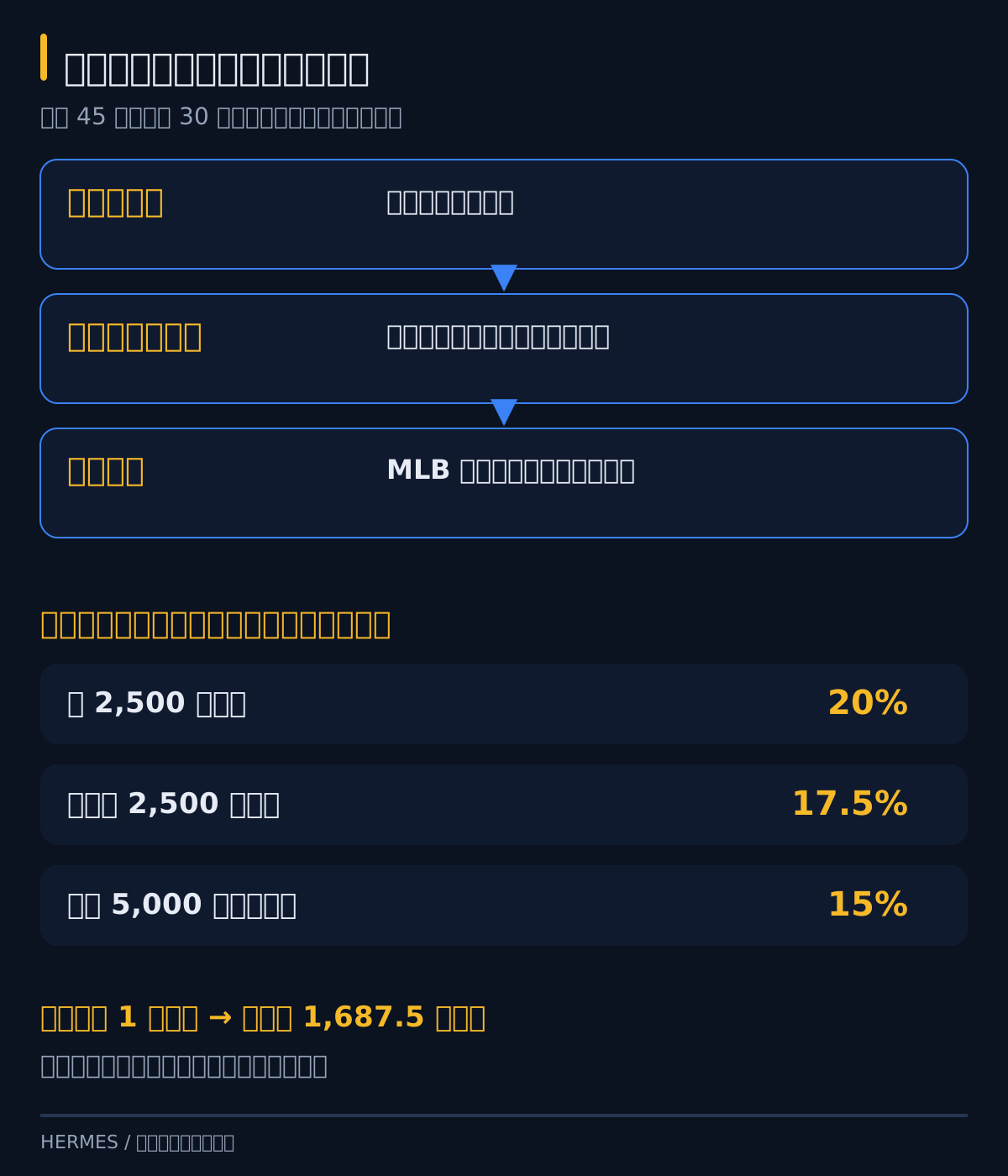
For example: On a $100,000,000 contract, the release fee = $5,000,000 + $4,375,000 + $7,500,000 = $16,875,000. The release fee is paid separately by the MLB team and is not deducted from the player's contract.
The Age-25 Rule: Why Some Prodigies Only Receive Minor League Contracts
MLB's international amateur rules state that foreign players who are under 25 years old or have fewer than 6 years of professional service time can only sign minor league contracts, with their signing bonuses subject to the team's "international signing bonus pool" limits, which usually amount to only a few million dollars.
This is why Shohei Ohtani and Roki Sasaki both went to MLB at a young age yet received very small contracts; also, because release fees are calculated based on contract value, NPB clubs usually prefer players to wait until they are 25 or older before being posted so that the club can receive a respectable release fee.
3What About CPBL Players?
The CPBL and Major League Baseball signed a Posting System Agreement on March 8, 2019. The 2018 case of Wang Po-Jung, often cited as an example, occurred before the agreement was signed and cannot be used to conclude that there is still no posting system today.
Once CPBL players meet the league's overseas transfer qualifications and obtain their club's consent, they can challenge MLB through posting; specific qualifications, postings, and negotiation procedures must be confirmed based on the league regulations and club announcements of that season. Direct signings by young Taiwanese players as international amateurs and going abroad after obtaining free agency status remain the other two paths.
4NPB Overseas FA: Not Simply 9 Calendar Years
To obtain overseas free agency eligibility, NPB players must in principle accumulate 9 seasons of first-team active roster service time. NPB calculates this by days on the first-team active roster; reaching 145 days on the roster counts as one season, and seasons with fewer than 145 days can have their days combined and accumulated, meaning that being with a team for 9 calendar years does not necessarily meet the criteria. If a player has already exercised domestic FA rights, accumulating an additional 4 seasons of first-team active roster service time also grants overseas FA eligibility. Once obtained, a player may head to the US without going through posting, and the original club receives no posting release fee. These are NPB regulations and should not be applied directly to KBO.
5How the MLB Free Agent Market Opens
- The day after the World Series ends: Players whose contracts have expired and who have accumulated 6 years of service time officially become free agents, and their original teams may re-sign them first.
- 5:00 PM ET on the 5th day after the World Series ends: Free agents can sign with any team, and the market officially opens.
- These 5 days are also the deadline for the Qualifying Offer (QO): Original teams may extend a one-year, fixed-amount offer to their own free agents. The 2026-27 QO is $23,150,000 (ESPN/AP Oct 19, per a memo sent by MLB to teams), up 5.1% from last year's $22,025,000; the amount is recalculated annually based on the average of the top 125 MLB salaries. The deadline for players to accept or reject the QO is Nov 17 at 13:00 PT (Taiwan Nov 18 at 05:00; official original text unavailable, per the schedule reprinted by https://www.yardbarker.com/mlb/articles/key_mlb_offseason_2026_dates_free_agency_roster_deadlines_winter_meetings_more/s1_17075_44493126 ). If a player rejects it and signs with another team, the original team can receive draft compensation.
How to look at Taiwan time: This year's World Series was won by the Brewers on Oct 28 (ET) in Game 5 with a 4-1 series victory. Calculated based on "the 5th day after it ends," the market opens around Nov 2 (Mon) at 17:00 ET, which converts to Taiwan Nov 3 (Tue) at 06:00; the actual opening time is subject to official MLB announcements. The period around the Winter Meetings in early December is when major contracts are most heavily concentrated.
Keep an eye on the Collective Bargaining Agreement (CBA): The current CBA expires on Dec 1 at 23:59 ET, which is Taiwan Dec 2 (Wed) at 12:59. MLB has already issued a memo instructing teams to prepare for a lockout; once a lockout begins, trades and signings are frozen. During the 2021-22 lockout, MLB and NPB agreed to freeze the posting negotiation window (Seiya Suzuki was posted on Nov 22 and had used only about 10 days before the lockout, with the remaining ~20 days resuming after the lockout ended). Reportedly, Teruaki Sato's posting window will not be paused by a lockout this year, giving him an effective window of about 30 days, requiring him to sign before Dec 1 at 17:00 ET (official original text unavailable, reported only in the media; see https://sports.yahoo.com/mlb/article/posted-npb-kbo-players-reportedly-must-sign-before-current-mlb-cba-ends-on-december-1-181736459.html ). For Sato's posting timeline, see the Teruaki Sato posting article. This article is based on the current system; a new CBA may adjust posting rules. (Reported by MLB Trade Rumors and CBS Sports, see sources)
6Asian Players to Watch This Offseason
Each year's posting list is not official until clubs make formal announcements, with names announced progressively from November to December. Taiwanese fans can pay special attention to:
- Teruaki Sato: Hanshin announced on Oct 19 that it agreed to post him (MLB.com). MLB officially posted him on Nov 1 ET, with negotiations eligible to begin on Nov 2; the 45-day window is calculated from the posting date, not Oct 19 (see https://www.mlb.com/news/teruaki-sato-mlb-posting-system ; the same posting batch also included Kaima Taira, Hiromi Itoh, and KBO's Si-hwan Roh, see https://apnews.com/article/japanesekorean-players-posted-mlb-baseball-53176d80932384564ce802bde95e6de1 ). He won the Central League batting Triple Crown this year with a .306 batting average, 39 home runs, and 106 RBIs; he turns 28 next year and is not subject to the Age-25 Rule.
- Whether ace pitchers and key hitters from various NPB teams receive posting approval from their clubs.
- Posting news regarding KBO stars (the KBO negotiation window is only 30 days, so the pace is faster).
- Movements of Taiwanese players in NPB can be found in the Taiwanese players section of How the Japan Series and Korean Series Work.
7FAQ
Does being "won" by an MLB team in posting mean the player must go?
The current system is not a highest-bidder system; instead, all 30 teams can negotiate with the player, and the player chooses the team they want to join. If no deal is reached within the deadline, the player returns to their original club.
Who pays the release fee?
The MLB team that signs the player pays it separately to the original club; it is not deducted from the player's contract.
If not posted, how long does it take for an NPB player to freely go to MLB?
NPB overseas FA generally requires accumulating 9 seasons of first-team active roster service time, with 145 days on the active roster counting as one season (seasons falling short can be combined and accumulated); players who have already exercised domestic FA can also qualify by accumulating an additional 4 seasons thereafter. After obtaining overseas FA, a player does not need to go through posting, and the original club receives no posting release fee. Do not confuse this NPB service time calculation with KBO regulations.
Why do some players prefer to wait until age 25?
Because before age 25, players can only sign minor league contracts with capped signing bonuses; they must be both at least 25 years old and have accumulated at least 6 seasons of service time in an MLB-recognized overseas professional league to avoid international amateur signing bonus pool restrictions; age alone is not the only factor.
To view MLB schedules and scores, please visit MLB; for how the postseason works, please see MLB Postseason Format.
8Sources
- MLB.com Glossary, "Japanese Posting System"
- NPB Official, "About the Free Agent System" (Overseas FA 9 seasons, 145 first-team active roster days per season, additional 4 seasons after exercising domestic FA)
- MLB.com Glossary, International Free Agency: Asia professional (explaining that players with 9 years of NPB/KBO professional service can head to the US as free agents without posting)
- Sports Illustrated, "Explaining How the Japanese Posting System Works in MLB"
- Baseball-Reference Bullpen, "Posting System" (KBO 30 days, release fee tiers)
- MLB.com Glossary, "Qualifying Offer"
- NBC Sports, "MLB free agency 2026: players, dates, qualifying offer"
- MLB Trade Rumors, "Lamigo Monkeys To Post Wang Po-Jung" (2018)
- CPBL Stats, "MLB, CPBL Posting System Work in Progress"
- Central News Agency, "CPBL and MLB Sign Player Agreement, Regulations Identical to Japan and Korea" (2019-03-08)
- MLB.com, "Korean Posting System"
- CPBL Official: CPBL and MLB Sign Player Posting Agreement
- ESPN, "MLB qualifying offer for free agents rises to $23.15 million" (2026-10-19)
- MLB.com, "Teruaki Sato posting" (2026-10-19)
- MLB Trade Rumors, "MLB sends memo to teams outlining lockout procedures"
- CBS Sports, "MLB lockout: how work stoppage impacts Seiya Suzuki and other NPB players coming to MLB"

A-Ji
A-Ji covers MLB, NPB and baseball data across leagues. He considers plate appearances, pitcher usage, fielding position and schedule context together rather than leaning on a single statistic, with a focus on format differences, useful metrics and overseas players followed in Taiwan.
View profile and articles ›