 Premier League
 Champions League
 LaLiga
 Serie A
 Bundesliga
 Ligue 1
 National teams
 MLB
 CPBL
 NPB
 KBO League
 Taiwanese players abroad
 League of Legends
 VALORANT
 CS2
 Dota 2
How to Watch MLB's New 2026 Rules: Pitch Timer and ABS Ball-Strike ChallengesGuides · Baseball · Formats & rules
Key points
- Pitching motion must begin within 15 seconds with bases empty and 18 seconds with runners on base
- 2 ABS challenges per team, retained if successful
- Same number of ABS challenges in the postseason, only replay challenges increase by 1
1Quick Summary
- Pitchers must "begin their pitching motion" before the timer reaches zero; the pitch does not have to reach home plate. It is 15 seconds with bases empty and 18 seconds with runners on base; a violation results in an automatic ball.
- Batters also have a deadline: with 8 seconds remaining on the countdown, they must be in the batter's box and alert to the pitcher, otherwise an automatic strike is called.
- ABS is a challenge system: the home plate umpire calls balls and strikes as usual, and only the batter, pitcher, or catcher can immediately challenge if they disagree on the spot.
- Each team starts the game with 2 ABS challenges; successful challenges are retained, and 1 challenge is deducted only if the call stands. If a team has zero challenges at the start of an extra inning, 1 challenge is added.
- ABS debuted in the Major Leagues in the 2026 regular season and continues into the postseason; timer seconds, how ABS is challenged, and the number of challenges are identical to the regular season. What is actually added in the postseason is manager replay challenges (2 versus 1), and extra innings do not have an automatic runner on second base.
The pitch timer regulates game pace, while ABS handles the few contested ball-strike calls; both systems often appear back-to-back in the same plate appearance. When watching broadcasts, first distinguish between "who committed a timer violation" and "who is challenging the umpire's call," and most of what happens on screen will make sense.
2Exactly How Many Seconds Are on the Pitch Timer
MLB introduced the pitch timer in 2023, shortened the time with runners on base from 20 seconds to 18 seconds in 2024, and carried these rules into 2026:
| Scenario | Timer | What the Player Must Do |
|---|---|---|
| Between batters | 30 seconds | Next batter prepares to enter the box |
| Bases empty | 15 seconds | Pitcher begins pitching motion before zero |
| Runners on base | 18 seconds | Pitcher begins pitching motion before zero |
| 8 seconds remaining on countdown | — | Batter enters the batter's box, alert to the pitcher |
The most common misconception is assuming the ball must leave the pitcher's hand or reach the catcher's mitt before 0 seconds. The rule looks at when the pitcher begins the pitching motion, so even if the broadcast timer hits 0, a screenshot alone cannot determine a violation; one must look at whether the pitcher has already started their motion.
If the pitcher exceeds the time limit, an automatic ball is added to the count; if the batter is not set before 8 seconds, an automatic strike is added. Enforcement takes effect immediately with no warning: on a full count, a pitcher violation results in an immediate walk, and with two strikes, a batter violation results in an immediate strikeout.
3Limits on Pickoffs and Disengagements
With runners on base, if the pitcher attempts a pickoff or steps off the rubber, the 18-second timer resets, but pitchers are limited to 2 "disengagements" per plate appearance, with both pickoff attempts and step-offs counting. If any runner advances during the plate appearance, the count resets.
A third pickoff attempt is still permitted, but with a risk: if the runner is not put out, the runner automatically advances one base. Therefore, after using the first two disengagements, the pitcher must successfully record an out on a third attempt.
Pitching coach mound visits, injury timeouts, and offensive timeouts do not count toward these 2 disengagements. If a team exhausts its 5 allowed mound visits prior to the ninth inning, an additional visit is granted in the ninth inning, which effectively provides an extra disengagement opportunity. Umpires may also grant additional time in special situations, such as when the catcher was forced out to end the previous half-inning and needs time to put on protective gear. Seeing the timer paused or reset is usually an authorized pause under the rules, so there is no need to jump to the conclusion of a missed call.
4ABS Is a "Challenge System," Not an Electronic Home Plate Umpire
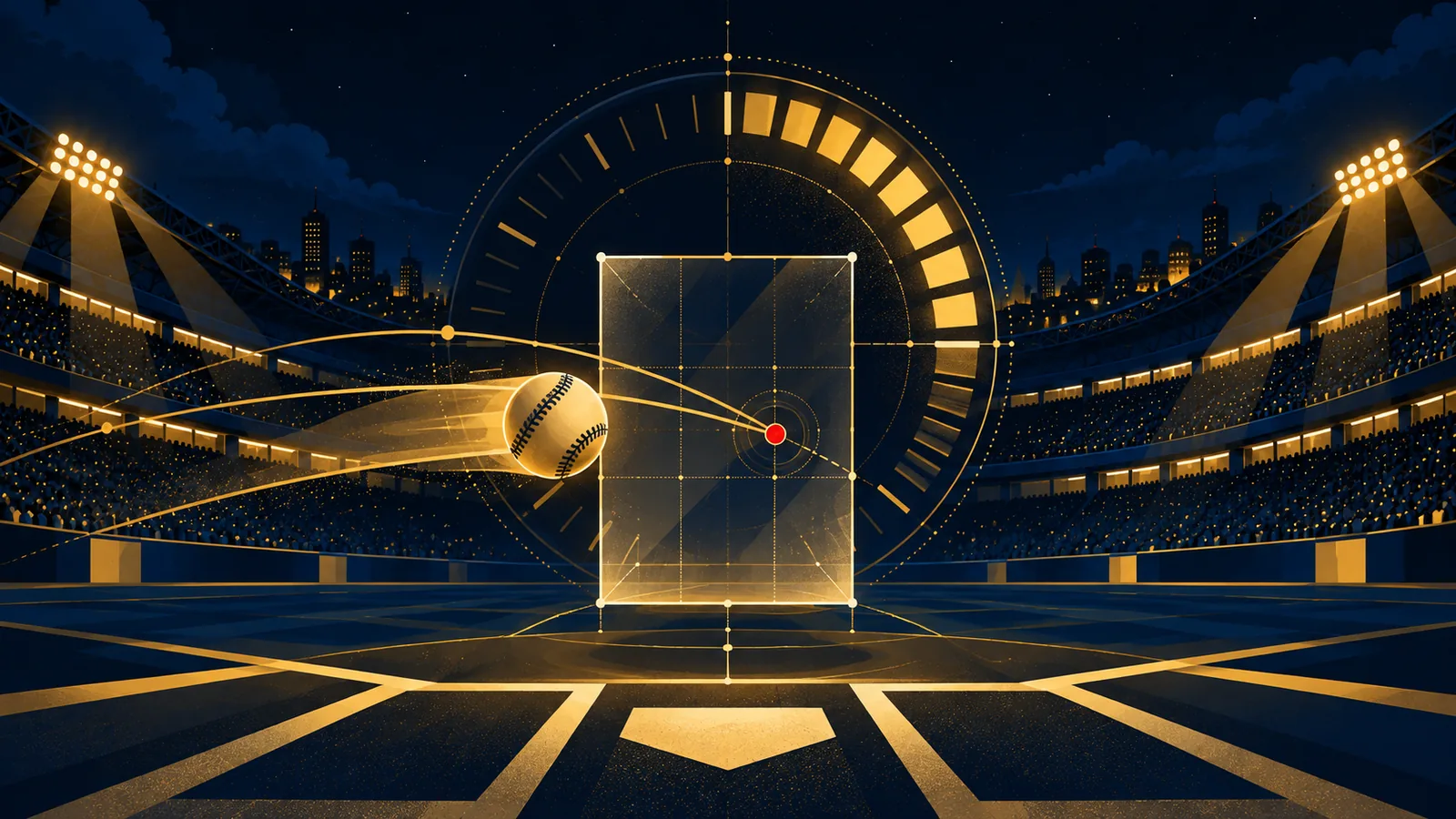
ABS stands for Automated Ball-Strike System. In 2026, Major League Baseball adopted a challenge system: the home plate umpire calls balls and strikes as normal, and only when an eligible player questions the call on the spot does the system verify the pitch's location.
Twelve Hawk-Eye cameras around the ballpark track the flight of the ball. The ABS strike zone is a two-dimensional rectangle above the midpoint of home plate, with the same 17-inch width as home plate. Its top edge is set at 53.5% of the player's height, and its bottom edge is at 27%, using league-certified height figures. If any part of the ball touches any part of the strike zone, it is called a strike.
Consequently, television broadcast strike zone overlays, umpire calls, and ABS results may occasionally disagree. The broadcast overlay is merely a visual aid, while ABS uses its own tracking data to determine whether the ball touched the two-dimensional strike zone at the midpoint of home plate.
5Who Can Challenge and How It Is Initiated
Only the active batter, pitcher, or catcher can challenge. Managers, coaching staffs, infielders, outfielders, and baserunners cannot, nor can players look for signals from the dugout before deciding.
Players must tap their cap or helmet immediately following the umpire's call and verbally indicate a challenge. MLB specifies the time limit as "immediate," roughly within two seconds; if the pitch is followed by a check-swing appeal or play on the bases, the challenge can be issued once that action concludes.
Once the umpire accepts the challenge, the stadium videoboard and broadcast display an animated graphic of the result, and the home plate umpire announces whether the call stands or is overturned. When MLB unveiled the system, it estimated the entire process would take around 15 seconds; testing during 2025 spring training averaged 13.8 seconds. The goal is to correct critical missed calls without slowing down the game, not to send every pitch to replay.
6How Many Challenges Each Team Gets and When They Are Deducted
Each team starts the game with 2 ABS challenges, shared by the entire team, not 2 per player.
- Successful challenge, call overturned: The challenge is retained.
- Unsuccessful challenge, call stands: 1 challenge is deducted.
- Technical malfunction, pitch cannot be tracked: The call stands, and the team retains its challenge.
- Exhausted at the start of an extra inning: Restored to 1 for that inning; if it is at 0 again entering the next inning, another is added.
If a team still has 1 challenge remaining entering the 10th inning, an extra one is not granted; only when a team has 0 remaining at the start of an extra inning is 1 added. Therefore, the phrase "one extra challenge every extra inning" is somewhat broad; the precise rule is that a team has at least one challenge available at the start of each extra inning.
In addition, ABS challenges cannot be made when a position player is pitching, nor can an ABS challenge be issued following a replay review, preventing a continuous chain of challenges.
7Differences Between the Regular Season and Postseason
ABS is used continuously from spring training through the regular season and into the postseason. On September 29 (US date) in Game 1 of the NL Wild Card Series, Ozzie Albies of the Braves issued the first ABS challenge in postseason history in the 2nd inning, overturning a pitch originally called a strike into a ball; he subsequently walked and scored to tie the game at 1–1.
| Rule | 2026 Regular Season | 2026 Postseason |
|---|---|---|
| Pitch timer | 15 seconds bases empty, 18 seconds runners on base | Same |
| Batter alert deadline | 8 seconds on countdown | Same |
| Initial ABS challenges | 2 per team, retained if successful | Same |
| ABS extra-inning replenishment | Replenished to 1 if starting inning at 0 | Same |
| Extra-inning baserunner | Starts with runner on second from 10th inning | Starts with bases empty |
| Replay review challenges | Manager starts with 1 | Manager starts with 2 |
The last two rows are the easiest to confuse. ABS is a challenge initiated by players regarding balls and strikes, whereas replay reviews are used by managers for reviewable plays such as catches, tags, and force outs. Managers receive 1 additional replay challenge in the postseason, but ABS challenges remain at 2 per team.
Postseason extra innings do not feature a runner on second base, but the ABS replenishment rule functions as normal: the top of the 10th begins with the bases empty, and if a team has exhausted its challenges, it will still receive 1 for that inning. To learn how the entire postseason is played, continue reading 2026 MLB Postseason Format.
8Three Things to Look for on Broadcasts
First, check whether there are runners on base next to the timer: 15 seconds with bases empty, 18 seconds with runners on base—do not confuse the two countdowns.
Second, watch who taps their cap or helmet: only the batter, pitcher, and catcher can initiate an ABS challenge. If a manager steps out of the dugout, they are usually dealing with a replay review or asking for a rules clarification.
Third, see whether the outcome is "Call Overturned" or "Call Stands": overturned calls do not cost a challenge, while calls that stand do. If the screen shows a team still having 2 challenges late in the game, it could mean they have not challenged all game, or that their previous two challenges were both successful.
9Frequently Asked Questions
Must the ball leave the pitcher's hand when the pitch timer hits zero?
No. As long as the pitcher begins the pitching motion before zero, it is legal; when the ball leaves the hand or enters the mitt has no bearing on the call.
Can a manager request an ABS challenge?
No. Only the active batter, pitcher, or catcher can initiate one, and they cannot receive assistance from the dugout or other players. Managers can only use the separate replay review challenge system.
Is a challenge deducted if an ABS challenge is successful?
No. If the call is overturned, the challenge is retained; 1 is deducted only when the call stands, meaning a team can successfully challenge more than twice in a game.
Are there more ABS challenges in the postseason?
No, each team still starts with 2 challenges and retains them if successful. What increases in the postseason is the manager's replay review challenges, which go from 1 to 2.
Does ABS replace the home plate umpire in calling balls and strikes?
Not in 2026. MLB uses a challenge system where the home plate umpire calls every pitch first, and ABS verifies the location only when a player challenges in real time.
10Sources
- MLB, "Pitch Timer (2023 rule change)"
- MLB, "8 changes fans need to know for the '23 season" (disengagement limits and third pickoff rules)
- MLB, "MLB announces ABS Challenge System coming to the Major Leagues beginning in the 2026 season"
- MLB, "MLB to use ABS Challenge System starting in 2026"
- MLB, "MLB Extra Innings Rules for Playoffs 2024: Automatic Runners and Pitch Clock"
- MLB, "Manager Challenge" (replay challenge counts)
- MLB, "Here are Major League Baseball's ABS firsts"

A-Ji
A-Ji covers MLB, NPB and baseball data across leagues. He considers plate appearances, pitcher usage, fielding position and schedule context together rather than leaning on a single statistic, with a focus on format differences, useful metrics and overseas players followed in Taiwan.
View profile and articles ›