 Premier League
 Champions League
 LaLiga
 Serie A
 Bundesliga
 Ligue 1
 National teams
 MLB
 CPBL
 NPB
 KBO League
 Taiwanese players abroad
 League of Legends
 VALORANT
 CS2
 Dota 2
2026-27 NBA Salary Cap, Luxury Tax, and Trade Rules in Plain English: What Are the First and Second Aprons?Guides · Basketball · Formats & rules

Key points
- The NBA has a soft cap; teams can legally exceed the salary cap using exceptions
- The 2026-27 salary cap is $164.96 million
- The luxury tax applies only to the portion exceeding the tax line and is tiered and progressive
1The Bottom Line First
- The NBA's salary cap is a "soft cap." Teams can legally exceed the cap using exceptions like Bird rights and the Mid-Level Exception (MLE), which is why most teams' payrolls sit above the cap.
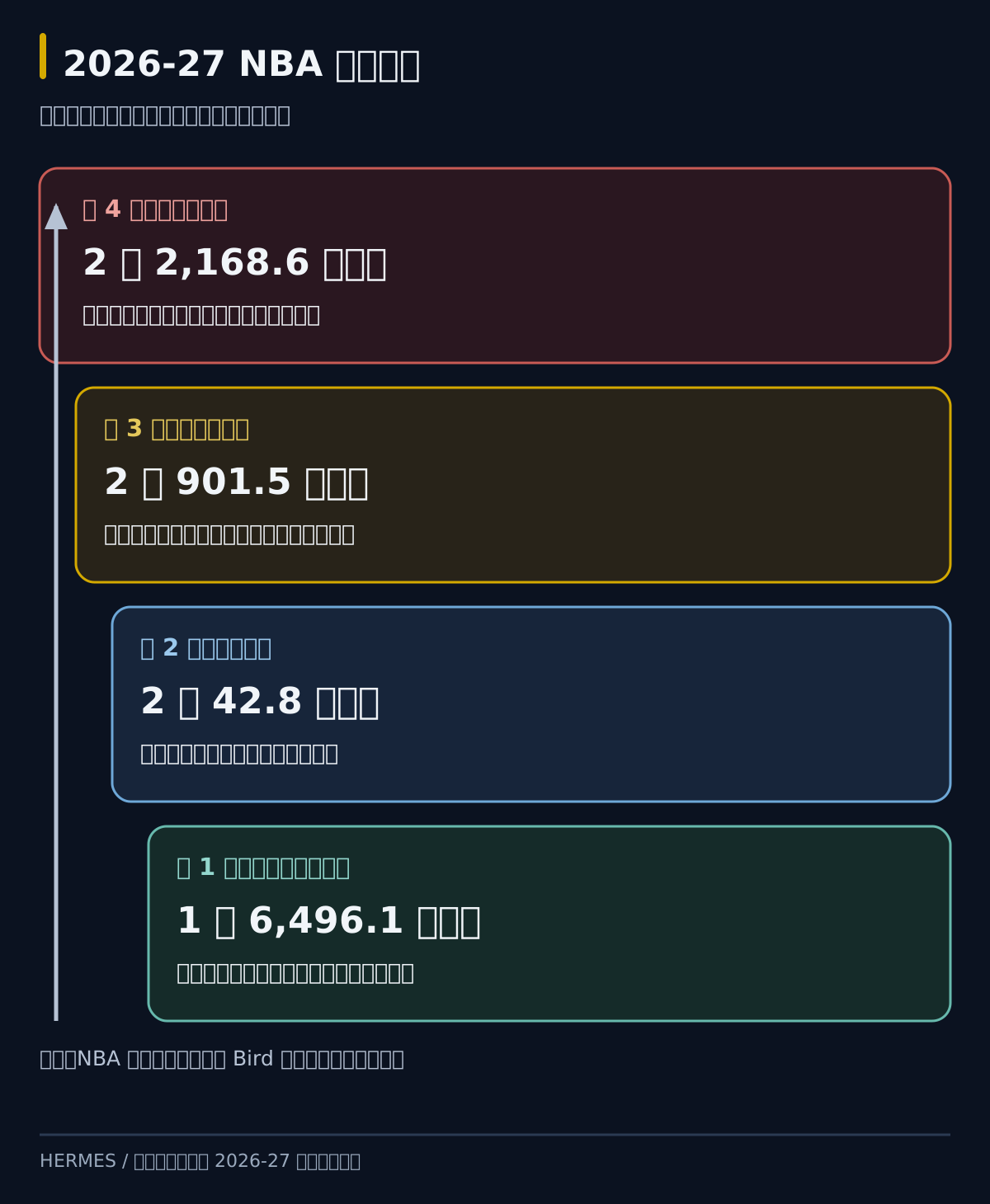
- Key figures for 2026-27: Salary cap: $164.96 million. Luxury tax line: approximately $200.43 million. First apron: approximately $209.02 million. Second apron: approximately $221.69 million.
- The luxury tax is progressive. The more a team exceeds the tax line, the heavier the tax per dollar. "Repeat offenders" who pay the tax in multiple consecutive years face even higher tax rates.
- What truly restricts teams are the two aprons. Exceeding the first apron significantly reduces roster-building tools. Exceeding the second apron prevents aggregating multiple contracts in trades and can result in future draft picks being frozen.
- The overarching principle of trades is that salaries must match. The trade deadline for the 2026-27 season is 3:00 p.m. ET on Feb 11, 2027, which is 4:00 a.m. on Feb 12 Taiwan time.
2What Is a Soft Salary Cap? Why Can Teams Exceed It?
The NFL has a hard cap, where exceeding the total payroll ceiling is a violation. The NBA has a soft cap. The salary cap primarily restricts "using cap space to sign free agents from other teams," but the league provides numerous "exceptions" that allow teams to retain players and add talent even after exceeding the cap.
The three most important exceptions:
- Bird Rights (retaining own players): Once a player spends a qualifying number of years with the same team, the team can re-sign him regardless of the salary cap, up to a maximum contract. This is why teams can keep their own stars, and why their total payroll balloons over time.
- Mid-Level Exception (MLE, adding outside players): Teams already above the cap receive an annual allowance to sign free agents from other teams. For 2026-27, there are three types:
- Standard version (Non-Taxpayer MLE): up to $15.044 million
- Taxpayer version: up to $6.064 million
- Room version (for teams with cap space): up to $9.366 million
- Minimum Salary Exception: Regardless of how high their payroll is, every team can sign players to the league minimum to fill out their roster.
However, a "soft cap" can also become hard. A hard cap is not two fixed ceilings, but rather is triggered by specific actions, after which a team cannot exceed the first or second apron for the remainder of that season: for example, using the Non-Taxpayer Mid-Level Exception or acquiring a player via sign-and-trade triggers a hard cap at the first apron; using the Taxpayer Mid-Level Exception, aggregating contracts sent out in a trade, or including cash triggers a hard cap at the second apron.
32026-27 Official Figures
The NBA announced the following figures on June 30, 2026, effective July 1.
| Item | 2026-27 Amount (USD) | Plain English Explanation |
|---|---|---|
| Salary Floor | $148.465 million | The minimum amount a team must spend; if not reached by opening night of the regular season, not only must the shortfall be distributed to players, but the team also forfeits its luxury tax distribution that season |
| Salary Cap | $164.961 million | A team must be below this line to sign outside free agents directly using "cap space" |
| Luxury Tax Line | $200.428 million | If payroll exceeds this line at the end of the season, the team must pay the luxury tax |
| First Apron | $209.015 million | Once exceeded, many roster-building tools become unavailable |
| Second Apron | $221.686 million | The most restrictive threshold |
| Non-Taxpayer Mid-Level Exception | $15.044 million | Used by non-taxpaying teams to sign players |
| Taxpayer Mid-Level Exception | $6.064 million | Used by teams above the first apron (but not exceeding the second apron); using it hard-caps the team at the second apron for that season |
| Room Mid-Level Exception | $9.366 million | Used by teams after exhausting their cap space |
4How the Luxury Tax Is Calculated
The luxury tax applies only to "the portion exceeding the tax line," and it is bracketed and progressive. For 2026-27, each tier's bracket width is $6.064 million, and this width adjusts annually alongside the salary cap.
| Amount Over Tax Line | Standard Teams: Tax per $1 Over | Repeat Offenders: Tax per $1 Over |
|---|---|---|
| $0–$6.064M | $1.00 | $3.00 |
| $6.064M–$12.128M | $1.25 | $3.25 |
| $12.128M–$18.192M | $3.50 | $5.50 |
| $18.192M–$24.256M | $4.75 | $6.75 |
| Above that | Increases by $0.50 each tier | Increases by $0.50 each tier |
Repeat offenders: Teams that paid the luxury tax in at least three of the previous four seasons have their tax rates jump to the higher tier.
Plain English example: Suppose a team's end-of-season payroll exceeds the tax line by $10 million.
- Standard team: First $6.064 million × 1.00 = $6.064 million. Remaining $3.936 million × 1.25 = $4.92 million. Total tax is approximately $10.98 million, slightly higher than the excess salary itself.
- Repeat offender: $6.064 million × 3.00 = $18.192 million. $3.936 million × 3.25 = $12.792 million. Total tax is approximately $30.98 million, nearly 3 times that of a standard team.
Consider another extreme scenario: a standard team exceeding the tax line by $24 million owes approximately $62.46 million in tax. The actual money the owner must pay equals the player salaries plus a massive penalty.
After luxury taxes are collected, up to 50% is distributed equally among teams that did not pay the luxury tax and met the salary floor, while the remainder is used by the league for centralized purposes. Therefore, "not paying the tax" itself allows a team to receive extra money.
5What Do the Two Aprons Restrict?
The original English term "apron" means an apron; Taiwan media mostly translates it as "tu-hao line" (tycoon apron), while some call it a "threshold." The restrictions are layered: for teams exceeding the second apron, all restrictions of the first apron also apply.
| Restriction | Exceeding First Apron | Exceeding Second Apron |
|---|---|---|
| Sign players using the Non-Taxpayer MLE ($15.044M) | ✗ Not allowed | ✗ Not allowed |
| Sign players using the Taxpayer MLE ($6.064M) | ✓ Allowed | ✗ Not allowed |
| Acquire players via sign-and-trade | ✗ Not allowed | ✗ Not allowed |
| Take back more salary than sent out in a trade | ✗ Not allowed (can take back at most 100%) | ✗ Not allowed |
| Sign buyout players waived during the regular season whose pre-waiver salary exceeded the Non-Taxpayer MLE | ✗ Not allowed | ✗ Not allowed |
| Aggregate two or more contracts in a trade (salary aggregation) | ✓ Allowed | ✗ Not allowed |
| Include cash in a trade | ✓ Allowed | ✗ Not allowed |
| Send out own player via sign-and-trade to acquire someone in return | ✓ Allowed | ✗ Not allowed |
| Draft pick freeze | None | If above the line at the end of the regular season, the first-round pick 7 years out is frozen and cannot be traded |
Draft pick freezing explained more plainly: For a frozen first-round pick, the team must stay below the second apron in at least three of the next four seasons for it to unfreeze. If the team remains above the second apron in two or more of the next four years, the pick is automatically moved to the very end of that year's first round, no matter how poor the team's record is that season.
6Trade Rules in Plain English
1. Salaries Must Match (matching salary)
When a team over the salary cap makes a trade, the outgoing salary must be "roughly comparable" to the incoming salary. The general principles are:
- Teams below the first apron: Can take back more salary, with the specific allowance depending on the outgoing salary bracket and the current season's payroll. However, if the trade triggers a first-apron hard cap, the team's payroll cannot exceed the first apron that season.
- Teams above the first apron: Incoming salary cannot exceed outgoing salary.
- Teams above the second apron: In addition to the rule above, they cannot aggregate multiple contracts to trade for a single larger contract (multiple-for-one is not allowed); conversely, trading one larger contract for multiple smaller contracts is permitted.
Teams that remain below the salary cap have more freedom and can directly absorb contracts from other teams using cap space.
2. Newly Signed Free Agents Must Wait Before Being Traded
Free agents signed in the offseason cannot be traded until either "three months after signing" or "December 15," whichever is later. Exception: Players re-signed by their team using Bird or Early Bird rights whose first-year salary exceeds 120% of their previous contract must wait until either "three months after signing" or "January 15," whichever is later; players who sign contract extensions prior to expiration are subject to different rules and are not governed by the December 15 date.
- The restriction lifting date for the 2026-27 season is Dec 15, 2026 (Tuesday in US time; Wednesday, Dec 16 in Taiwan). This is why trade rumors and news suddenly surge in mid-December each year.
- Free agents signed after Nov 11, 2026 must wait three months before they can be traded, which effectively means they cannot be moved before that season's trade deadline.
3. The Trade Deadline
- 2026-27 Trade Deadline: 3:00 p.m. ET on Thursday, Feb 11, 2027
- Converted to Taiwan time: 4:00 a.m. on Friday, Feb 12, 2027
- After the deadline passes, teams can no longer make trades; they can only sign free agents or waived players.
7How These Rules Affect the News You See
- "Must shed salary before making additions": When a team is hovering near an apron, before signing or trading for someone, it often must first shed a contract to drop payroll below the line, regaining the ability to use an MLE or aggregate salaries.
- "Trading role players to save on tax": Sometimes the player traded away is not an underperformer, but rather someone whose salary relative to their role is cost-inefficient. The savings can amount to multiple times that salary in tax penalties.
- "Piecing together multiple small contracts in a trade": Only teams below the second apron can aggregate salaries, which is why you see "three-for-one" trades. Teams above the second apron cannot execute such moves.
- "Draft picks are frozen": When the news reports that a team "has no trade assets left," it is sometimes because their first-round picks are frozen, or were already dealt away earlier.
- "Trade activity picks up after Dec 15": Offseason free-agent signees become eligible to be traded starting on this date, suddenly expanding the pool of tradeable contracts.
8Frequently Asked Questions
Q1: Is a higher salary cap always better? For teams looking to sign free agents, a higher cap means more cap space. However, the tax line and aprons also adjust upward alongside it, so the restrictions themselves do not disappear.
Q2: Is a team in the clear as long as it doesn't pay the luxury tax? Not necessarily. A team that uses the Non-Taxpayer MLE or acquires a player via sign-and-trade becomes "hard-capped," meaning its payroll cannot exceed the first apron for that season; using the Taxpayer MLE, aggregating contracts sent out in a trade, or including cash means it cannot exceed the second apron. Even without paying the luxury tax, those restrictions still apply.
Q3: Which date determines the payroll for luxury tax calculation? It is primarily determined by the team's payroll at the conclusion of the regular season. This is why some teams execute "tax-saving trades" mid-season or before the trade deadline to bring payroll below the line.
Q4: How does a team get out of repeat offender status? By spending enough seasons below the tax line. Once the condition of "paying the tax in three of the previous four seasons" no longer holds, the tax rate returns to the standard schedule.
Q5: Are the apron numbers the same every year? No. These thresholds adjust every year along with league revenue and the salary cap, typically announced between late June and early July.
---
For NBA standings and schedules, see NBA; to learn how the NBA Play-In Tournament and playoffs work, see this guide.
9Sources
- Salary cap, luxury tax line, first and second aprons, salary floor, three types of MLE, effective date: NBA official press release "NBA sets Salary Cap for 2026-27 season"
- 2026-27 luxury tax bracket width ($6.064 million) and tax rate table: Salary Swish 2026-27 Luxury Tax Tracker https://www.salaryswish.com/luxury-tax/2027; Stocks & Buckets (2026-27 figures)
- Tax rate adjustments beginning in 2025-26 (1.00 / 1.25; repeat offenders 3.00 / 3.25), repeat offender definition, tax distribution method: Hoops Rumors Glossary: Luxury Tax Penalties https://www.hoopsrumors.com/2024/11/hoops-rumors-glossary-luxury-tax-penalties-4.html; The CBA Guide
- Restrictions of both aprons, draft pick freezing rules: theScore "NBA's 2nd apron explained" https://www.thescore.com/nba/news/2940429; Hoops Rumors Apron Overview
- General principles of salary matching and salary aggregation: Hoops Rumors Glossary: Salary Aggregation
- 2026-27 trade deadline (3:00 p.m. ET on Feb 11, 2027), Nov 11 signing cutoff: Hoops Rumors https://www.hoopsrumors.com/2026/08/2027-nba-trade-deadline-set-for-february-11.html; Yardbarker
- December 15 trade restriction lifting rules: Hoops Rumors "Players Who Can't Be Traded Until December 15"
- 2026-27 opening night, All-Star dates (cross-confirming trade deadline): Bleacher Report

Xiao Qiao
Xiao Qiao covers NBA games, season formats and advanced statistics. She looks beyond the score to pace, efficiency, usage and lineup context, separating short-term shooting swings from longer trends and explaining each number with examples that new data-minded fans can follow.
View profile and articles ›