 Premier League
 Champions League
 LaLiga
 Serie A
 Bundesliga
 Ligue 1
 National teams
 MLB
 CPBL
 NPB
 KBO League
 Taiwanese players abroad
 League of Legends
 VALORANT
 CS2
 Dota 2
How to Read Football Stats: Possession, Shots, Shots on Target, and PPDA ExplainedGuides · Football · Stats explained

Key points
- High possession does not mean playing well, only the match pattern
- Shots show quantity, shots on target and xG show accuracy and chance quality
- PPDA is used to measure pressing intensity
1Summary
A match's football stats can be read through four questions:
- Who has the ball? → Possession. It only indicates who has the ball at their feet longer, not who is playing well.
- Who created chances? → Shots, shots on target, xG. Shots show "quantity," shots on target show "accuracy," and xG shows "chance quality."
- Who is pressing? → PPDA. The lower the number, the more aggressive the pressing to win the ball in the attacking half.
- Is the result fair? → Comparing the above metrics with the scoreline reveals whether the match was deserved, lucky, or a stolen result.
2Possession: At Whose Feet Is the Ball
Possession is the proportion of ball possession time (or pass counts) held by each team in a match, totaling 100%. Different data providers calculate it slightly differently—some use time, others estimate via pass counts—so different websites might differ by a few percentage points for the same match.
Common misconception: High possession = playing well. In fact, many teams "intentionally don't want the ball": retreating to defend their own half first and waiting for the opponent to push up before launching a counter-attack. In such matches, it is common for a side with 30% possession to win. Possession is better suited for looking at the match pattern—who controls the tempo and who waits to counter-attack—rather than predicting who wins or loses.
3Shots and Shots on Target: Quantity and Accuracy
- Shots: All attempts toward goal, including off-target and blocked shots.
- Shots on target: Shots that would enter the goal frame—that is, shots that would go in if not blocked, or those saved by the goalkeeper. Generally, shots blocked by defenders do not count as shots on target; however, according to Opta's definition, an attempt blocked near the goal line by the last line of defense that would otherwise have gone in is still counted as a shot on target.
Having many shots but few on target usually indicates too many long-range shots or forced efforts; having few shots but a high proportion on target indicates good chance selection. However, shot counts do not distinguish good from bad: a long-range shot from the edge of the penalty area and a tap-in 3 meters from goal both count as only 1 shot in the shot tally. Therefore, to see chance quality, one must look at xG.
4xG: Chance Quality
xG (expected goals) scores every shot: based on location, angle, whether it is a header, and so forth, it estimates "on average, what probability such a chance has of resulting in a goal." Adding up a team's xG for the entire match gives "how many goals should have been scored according to chance quality." For a complete explanation, see What is xG; to extend this further to "how many points should have been taken from this match," see Expected Points xPts.
5PPDA: How Aggressive the Pressing Is
PPDA stands for passes per defensive action, meaning "how many passes the opponent makes before our side makes one defensive action."
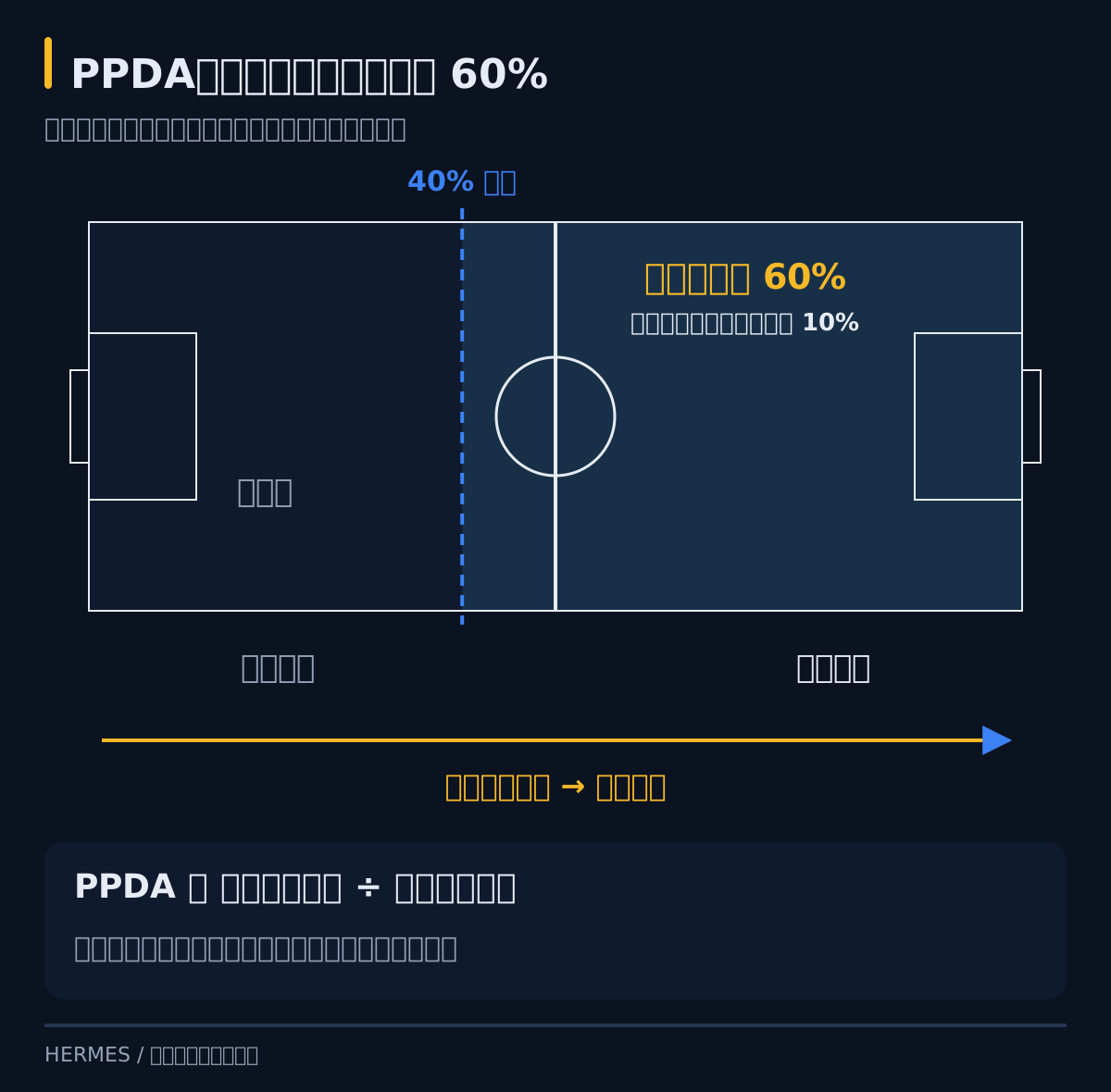
How it is calculated: It only looks at the 60% (three-fifths) of the pitch closest to the opponent's goal—that is, the forward 60% calculated from the opponent's own goal line forward,
Defensive actions include: tackles, interceptions, challenges (counted even if unsuccessful), and fouls.
How to read it:
- The lower the number, the more aggressive the pressing: The opponent only strings together a few passes before being challenged, indicating our side is very proactive in the attacking half.
- The higher the number, the more inclined toward retreating to defend: Allowing the opponent to pass in the front area and only defending once retreating in front of the penalty box.
For reference (Premier League official site citing Wyscout data, 2021-22 season): Liverpool's 8.62 was the lowest in the league (most aggressive pressing), closely followed by Manchester City and Chelsea; the lowest across the top five leagues that same season was Barcelona's 7.26, while the deepest defending teams were between approximately 15 and 17.
Blind spots of PPDA:
- For teams with heavy possession, opponents hardly have opportunities to pass, so PPDA will also tend to be low, not necessarily because the pressing is aggressive.
- It only counts occurrences, not whether the ball was actually won back.
- It does not reflect formation and positioning; two teams with the same PPDA may have completely different pressing styles.
6In Practice: How to Read a Match Using Stats
Suppose the stats for a match are as follows:
| Team A | Team B | |
|---|---|---|
| Score | 0 | 1 |
| Possession | 68% | 32% |
| Shots (Shots on target) | 18 (4) | 7 (3) |
| xG | 1.1 | 1.4 |
| PPDA | 9 | 16 |
How to read this:
- Team A had more possession, more shots, and pressed more aggressively, appearing to dominate the match.
- However, 18 shots produced an xG of only 1.1, indicating that most were low-quality long-range shots or attempts from tight angles.
- Team B took only 7 shots, yet had an xG of 1.4, indicating they defended deep, counter-attacked, and waited for several quality opportunities.
- Conclusion: Team B's win was not a "steal"; their chance quality was actually better. Team A's problem was "having possession, but no good chances."
7FAQ
Do teams with under 50% possession win more often?
Not necessarily. Strong teams mostly have high possession; however, in matches with a large disparity in strength, underdog teams that pull off upsets through deep defending and counter-attacks are often the side with very low possession. Therefore, possession should be examined alongside xG.
Are shots on target more important than shots?
Shots on target are more representative of threat, but they still do not differentiate quality; to compare the quality of chances, xG can supplement shot quality; different models may also have differences.
What PPDA value counts as a high press?
There is no absolute standard, but roughly under 10 is considered very proactive pressing, while above 15 leans toward retreating to defend; comparisons are only meaningful against other teams in the same league.
Where can these stats be found?
Official league websites and statistical websites provide them, and Hermes Stats match pages also compile basic stats like scores and shots, accessible from the Premier League or individual league pages.
8Sources

Old Parker
Old Parker covers the Premier League, Champions League, Europe's major leagues and international football. He reads matches through schedule load, home-field context and recent form, then uses the numbers to explain formats, qualification routes and viewing times for readers in Taiwan.
View profile and articles ›