 Premier League
 Champions League
 LaLiga
 Serie A
 Bundesliga
 Ligue 1
 National teams
 MLB
 CPBL
 NPB
 KBO League
 Taiwanese players abroad
 League of Legends
 VALORANT
 CS2
 Dota 2
How to Read F1 Tyre Strategy: Compounds, Colors, and Pit Stop RulesGuides · Other sports · Formats & rules
Key points
- Only C1–C5 dry compounds remain, with 3 chosen per race
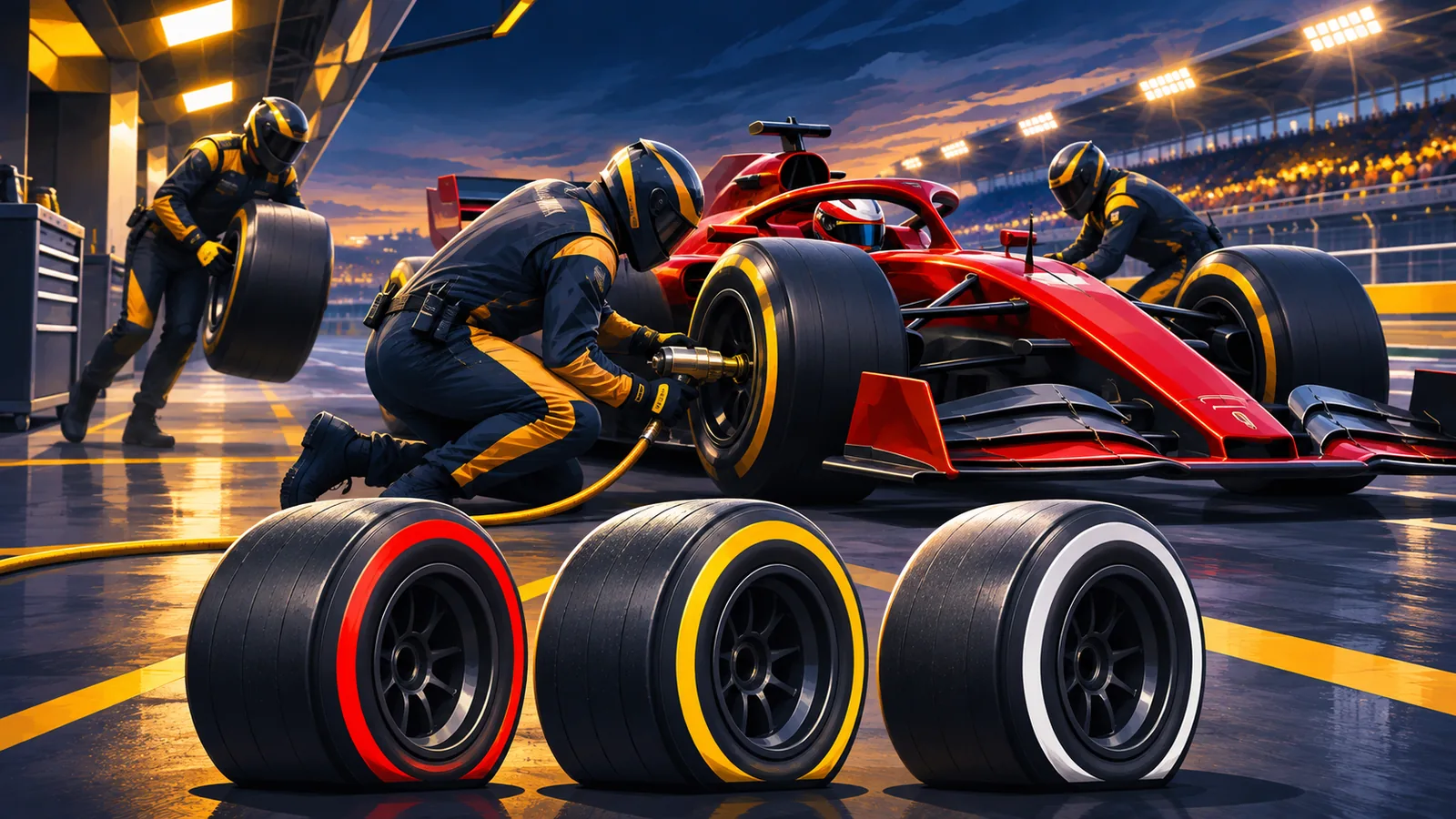
- Soft is red, medium is yellow, hard is white
- At least two different dry tyre compounds must be used in a dry race
1Summary
- Starting in 2026, Pirelli removed the softest C6 compound, leaving only five dry compounds, C1–C5, with 3 selected for each race.
- The 3 dry tyre compounds chosen for each race are designated by relative hardness as red for soft, yellow for medium, and white for hard.
- In a dry main race, at least two different dry tyre compounds must be used, requiring at least one pit stop.
2Only Five Dry Compounds Starting in 2026
Starting in 2026, Pirelli removed the softest C6 compound, leaving only five dry compounds from C1 to C5. For each race, 3 of these five are selected and brought to the track.
The reason for dropping the C6 was that the lap time delta between C6 and C5 was too small. Pirelli wanted the gaps between compounds to be larger and more consistent, giving teams more strategic options.
The 2026 season also features 24 races, and for every round, 3 dry compounds will be allocated from C1 to C5.
3How to Identify Tyre Colors
The 3 dry tyre compounds selected for each race are marked in three colors according to their relative hardness:
- Soft tyres: Red
- Medium tyres: Yellow
- Hard tyres: White
Wet-weather tyres also have their own colors: intermediate tyres are green, and full wet tyres are blue.
These colors represent the "relative hardness for that specific race," not a fixed compound number. When watching a broadcast, looking at the color on the tyre sidewall reveals which of the race's three compounds the driver is currently running.
4How Many Sets of Tyres per Weekend
Each weekend, the number of dry tyre sets allocated to each driver is as follows:
| Weekend Type | Total Dry Sets | Hard Tyres | Medium Tyres | Soft Tyres |
|---|---|---|---|---|
| Standard Race | 13 sets | 2 sets | 3 sets | 8 sets |
| Sprint Weekend | 12 sets | 2 sets | 4 sets | 6 sets |
In addition, there are 4 sets of intermediate tyres and 3 sets of full wet tyres.
The above allocations come from reports in June 2025.
5Dry Main Race: At Least Two Compounds Required
A dry main race has a crucial rule: at least two different dry tyre compounds must be used across the race. Therefore, drivers must make at least one pit stop to switch to a different compound.
This rule applies only to dry main races. It does not apply to sprint races or wet races, where drivers do not have to pit.
When watching a race, one key thing to check first is whether a driver has already switched to a second compound. Any driver who has only used a single compound will still need to pit to change tyres later.
62026 Tyre Specification Changes
Wheel rims will remain 18 inches in 2026, but tyre widths are reduced: front tyres are 25 mm narrower and rear tyres are 30 mm narrower, matching the smaller and lighter new cars.
The maximum tyre blanket temperature is lowered from 100°C to 70°C, and the maximum pre-race heating time is 2 hours.
7Key Strategy Points to Watch
- First, check the race's three dry compounds: which of the C1–C5 compounds correspond to red, yellow, and white, as it varies from race to race.
- Watch which tyre color the driver chooses for the start.
- Watch which color is fitted after the pit stop. In a dry race, at least two different compounds must be used; switching back to the same compound does not fulfill this requirement.
- Sprint weekends have 12 sets of dry tyres—4 sets of mediums and 6 sets of softs—which differs from the 3 medium sets and 8 soft sets allocated for standard race weekends.
- In wet races, watch for the green intermediate tyres and blue full wet tyres. The "at least two compounds" rule does not apply in wet races.
8Frequently Asked Questions
How many dry tyre compounds are there in F1 now?
Starting in 2026, there are five compounds, C1 to C5. Pirelli removed the softest C6 because the lap time difference between C6 and C5 was too small.
How many dry tyre compounds are used at each race?
For each race, 3 are selected from C1–C5 and marked by hardness as red for soft, yellow for medium, and white for hard.
What do the tyre colors represent?
For dry tyres, red, yellow, and white indicate the relative hardness of the three dry compounds at that race: red for soft, yellow for medium, and white for hard. For wet-weather tyres, intermediates are green and full wets are blue.
Is a pit stop mandatory in a dry main race?
Yes. In a dry main race, at least two different dry tyre compounds must be used, requiring at least one pit stop. This rule does not apply to sprint races or wet races, where drivers do not need to pit.
How many sets of tyres does each driver get per weekend?
A standard race weekend has 13 sets of dry tyres (2 hard, 3 medium, 8 soft), while a sprint weekend has 12 sets (2 hard, 4 medium, 6 soft). There are also 4 sets of intermediate tyres and 3 sets of full wet tyres. These numbers come from reports in June 2025.
9CTA
Next time you watch an F1 broadcast, first check that race's red, yellow, and white tyres, and then watch which color the drivers switch to after pitting. If you want to understand the qualifying procedure, you can continue by reading this site's qualifying guide.
10Sources

A-He
A-He is the newsroom's editor-in-chief, covering cross-sport topics, tools, rules explainers and esports. She starts with source quality and the current rulebook, then asks which numbers actually answer the reader's question, making definitions, limits and exceptions easy to compare across sports.
View profile and articles ›